
Pedal Triangles
By Tonya Brooks
Before
we begin to look at pedal triangles, it might be nice to know what they
are. If we take the triangle
formed from three lines and pick any point on the plane, we can construct a
pedal triangle by taking perpendicular lines through our point to the three
lines of the triangle. It might
look something like this:
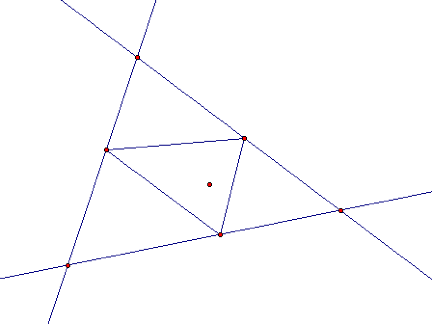
Now in this case, I
let my point be inside the triangle but there is no reason that it needs to be
(as we will see what happens when it is not). Also, for convenience, I have hidden the perpendicular
lines.
Now let’s move our
point around. One question we
might consider is whether or not the point will always be inside the pedal
triangle. We can see that if we
move our point around, we actually can get times when the point is outside the
pedal triangle. It happens when
our construction looks something like this:

Did you notice that
our point has moved outside our original triangle? One thing to notice is that when our point is on a side of
our original triangle that it becomes one of the vertices of the pedal
triangle. This seems to make sense
since we take the points where our perpendicular line through our point
intersects the lines of our triangle to create our pedal triangle.
Another thing to
notice is what happens when our point is one of the vertices of our original
triangle. As the point gets closer
to the chosen vertex, the two sides of the pedal triangle that intersect the
original triangle get closer and closer together until they eventually
meet. At this point, everything
comes together and our pedal triangle becomes a segment.
Do you notice
anything about this segment? Well,
from the way we constructed our triangle, the segment is perpendicular to the
line for the triangle, and it goes through one of the vertices, therefore it
becomes an altitude by definition.

As we continue to
play with our point, we can see that at times our pedal triangle goes outside
the original, like so:

By moving our point
around, we can get the pedal triangle to be half in and half out of our
original triangle or all the way outside as seen from above. It seems like our point just needs to
be far enough out of our original triangle.