
Last modified on May 21, 2012.
(Write-Up #7 instructions at the end . . .)
This investigation begins with the following problem.
Given two circles and a point on one of the circles. Construct a circle tangent to the two circles with one point of tangency being the designated point.
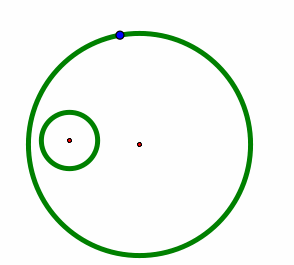


There are two different circles depicted by the red and blue circles in the last two images above. We will need both of them. So the construction should show both of them. Usually the completed construction puts both of the constructed circles on the same image.
We also want to explore these two tangent circles (red and blue) when the two given circles (green) are intersecting.
And, we want to explore the case where the two given circles (green) are completely separate or, disjoint. Here the red circle passes between the two given circles. It is internally tangent. The blue circle is externally tangent; it encircles both the given circles.
The Geometer's Sketchpad allows investigation, demonstration, and exploration. It is a tool for helping develop statements to be proved and the construction of new relationships. The set of circles tangent to two given circles is a very rich problem environment. GSP helps to visualize and demonstrate; it is a means to pose a considerable array of related problems and investigations.
Open a Java GSP to explore these tangent circles.
Click HERE if you need guidance on constructing the tangent circles.
Problems and investigations.
1. Make GSP constructions and script tools for construction of the tangent circles.
An appropriately constructed GSP Script Tool will enable you to investigate all the cases:
i. When one given circle lies completely inside the other
ii. When the two given circles over lap
iii When the two given circles are disjoint
Be sure to include your script tool in your library of script tools in Assignment 5.
2. Investigate, discuss, and state conjectures about the loci of the centers of the tangent circles for all cases you construct.
You should consider this for cases i, ii, and iii from Item 1.
If your conjecture is than a locus is an ellipse, provide justification.
If your conjecture is that a locus is a hyperbola, provide justification.
3. Examine the trace of the tangent line to the ellipse or hyperbola in each case.
4. Consider the locus of the midpoint of the segment that formed the base of the key isosceles triangle in each construction.
5. Using animation, consider the limit of the locus of centers as the two given circles approach being tangent.
6. Is the locus ever a parabola? Is it a parabola in some limiting case?
7. Consider loci of points other than the center constructed relative to the tangent circles. For example, consider points along the line through the point of tangency to one of the given circles and the center. Or consider some points along perpendiculars to the diameter through the point of tangency (try perpendiculars not through the center as well as the perpendicular through the center).
8. Given a line and a circle with center K. Take an arbitrary point P on the circle. Construct two circles tangent to the given circle at P and tangent to the line.
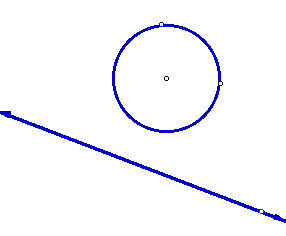
This case of the line and a circle might be considered the limiting case of the two disjoint circles. The line is in some sense a circle with an infinite radius.
9. Investigate. . . what else can you find?
Write-Up # 7.
Prepare a retrospective summary on your experience with this assignment. The summary might take a mathematical bent, stressing the underlying theorems and relationships. It might take a pedagogical bent, stressing the exploration and discovery. It might take a "here is something interesting I found" bent. Or . . . be creative . . .