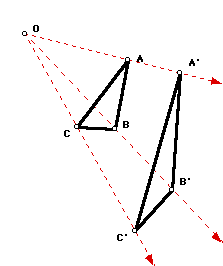
Two triangles are perspective from a line (the axis of perspectivity),
if their sides can be put into a one-to-one correspondence in such a way
that the axis of perspecitvity is concurrent with each pair of corresponding
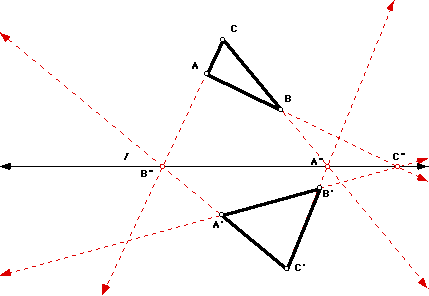
sides. In the picture below the triangles ABC and A'B'C' are perspective
from the line l. Corresponding sides are AB and A'B', AC and A'C', BC and
B'C', and we can see that each pair of corresponding sides are indeed concurrent
with the line l .
Once we have these two theorem we can now state Desargues theorem.
Desargues Theorem: If two triangles are perspective from a point,
they are perspective from a line, and conversly.
A formal proof of this can be found in Fishback (1969). However, it is possible
to do a GSP demonstration which will allow the explorer to try several cases
to see if the theorem holds. If you have GSP and would like to test the
part of the theorem that says perspectivity from a point, leads to perspectivity
from a line, Click here. If you would like
to test the part of the theorem, that says perspectivity from a line leads
to perspectivity from a point, Click here.
I have chosen several situations to explore using GSP, and I will try to
relate what I have found. Although I have not provided any proofs, I have
provided links to GSP sketches that I hope will convince the reader that
what I hav efound may be provable.
1) I first considered two coplanar triangles with corresponding sides parallel
(see the following picture)
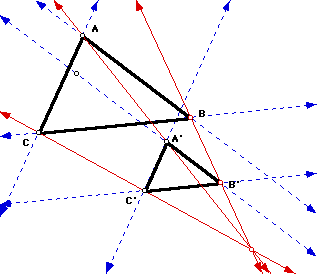
In this picture we have two triangles ABC and A'B'C', and they have been
drawn such that AB is parallel to A'B', AC is parallel to A'C', and BC is
parallel to B'C'. (Parallel lines are drawn in blue) If we draw lines between
corresponding poins of the triangles (i.e. A and A', B and B', etc.), we
see that the lines appear to intersect in a common point, or a point of
perspectivity. If this is the case, we can use Desargues theorem to claim
that the triangles are perspective to a line, and hence Desarguean. Unfortunately,
there may be one case that does not hold. If the triangles are congruent,
then the line AB will be parallel to the line A'B', the line AC will be
parallel to the line A'C', and the line BC will be parallel to the line
B'C'. In this case the lines will not intersect and we can have no center
of perspectivity. Also, if the one triangle is inside the other, the point
of perspectivity will be inside the inner triangle. Otherwise, it will be
outside of both. If you want to convince yourself of this using a dynamic
model and you have GSP, Click here.
2) Now, suppose I have a triangle and I join the midpoints of its three
sides. Are the two triangles Desarguean?
The picture of this situation is quite simple,
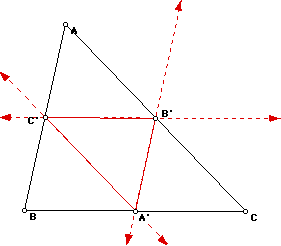
So here we have two triangles, ABC and A'B'C'. The proof of this is quite
simple since the line segment AB will be parallel to the line segment A'B',
the line segment AC will be parallel to the line segement A'C', and the
line segment BC will be parallel to the line segment B'C'. If we extend
the sides of each triangle, what we really have is a situation similar to
problem 1.
3) Suppose now that we have two coplanar triangles with the lines joining
corresponding veritices parallel. Are these Desarguean?
I beleive so. Again, it might be helpful to see a picture of the situation.
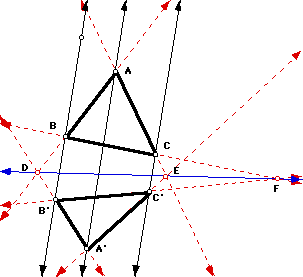
Here we have the two triangles ABC and A'B'C' drawn in such a way that
the lines AA', BB', and CC' are all parallel. In this picture, I have drawn
extensions of each of the sides of the triangles (in red). It can be noticed
that the line AB does intersect with the line A'B', the line AC does intersect
with the line A'C', and the line BC does intersect with the line B'C'. More
over, it appears that the three intersection points lie upon the same line
(in blue). If this is the case, we can use Desargues theorem to state that
the triangles are Desarguean . We do encounter a bit of a problem when one
side of a triangle is parallel to the corresponding triangle of the other
triangle. If you would like to convince yourself using GSP, click
here.
4) Suppose that we have three triangles that are Desarguean in pairs with
a common center of perspectivity, it can be demonstrated that the axes of
perspecivity are concurrent.
Here is a picture of the situation, where triangles ABC, A'B'C', and A"B"C"
are the triangles of the discussion.
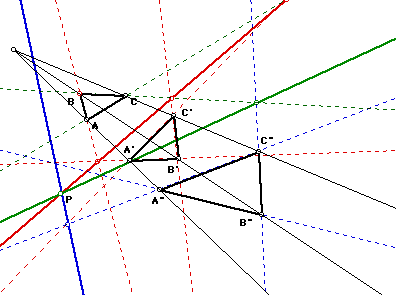
Let me try to clarify this picture a bit. Again, we have the three triangles
under discussion ABC, A'B'C', and A"B"C". The common point
of perspectivity is point in the upper left hand corner (sorry, I forgot
to lable it). The dark green line is the axis of perspectivity for triangle
ABC and triangle A"B"C", the dark red line is the axis of
perspectivity for triangles ABC and A'B'C', and the dark blue line is the
axis of perspecivity for triangle A'B'C' and A"B"C". Again
I think that there will be a problem when the triangles are similar or we
have a pair of triangles with one pair of corresponding sides parallel.In
this picture, it can be seen that the three axes of perspectivity do intersect
at the point P. If you would like to explore this situation using GSP, Click
Here.
Some other problems include:
Show that two congruent triangles in distinct planes with corresponding
sides parallel are Desarguean.
Show that if three triangles are Desarguean in pairs with a common axis
of perspectivity, the centers of perspectivity are collinear.
How can a person plant ten trees in ten rows of three each?