 x
x
x
x
Let us begin with the simplest case. The pair of functions
y = x - 2
y = x - 5will graph as parallel lines through the points (2,0) and (5,0) with slope of 1.
The product of these two functions y = (x - 2)(x - 5) is a parabola also passing through the points (2,0) and (5,0). The graph, showing all three functions, is as follows.
The same function is represented by the equation

Clearly, we could have started with any two lines through (2,0) and (5,0) respectively, and taken their product


to produce two lines and their corresponding parabola through the given points.
Going the other direction, we could take any of the family of parabolas through the points (2,0) and (5,0) with major axis along x = 3.5, ,and factor the equation into two linear factors representing lines through the given points.
Consider again the parabola with the equation
Let us look at rewriting it asand graphing it. The domain over which the function is defined in the real numbers is restricted to where 7x - 10 > 0. In this region, however, the graphs of the two equations are the same.The spurious vertical line results at the boundary of the defined region -- where 7x-10 approaches zero.
The rewritten equation is in the form of the difference of two squares and in factored form we have


That is, we have the function as the product of two functions and the graph of these two functions (on the same axis). The union of these two graphs appears to be a parabola. Is it?
A single equation for the union of two curves can be found by taking the product of the relations producing the curves. We set

and simplifying gives

This is the equation of a parabola passing through the points (2,0) and (5,0) having an axis of symmetry with slope of 1.
A Different Look Let us consider again the equation

For any constant a,

is the same graph. Now we have a slightly different way of putting this in the form of the difference of two squares:

and the factor functions are

Rewriting as the product of two relations to get the union of the graphs gives
This simplifies to

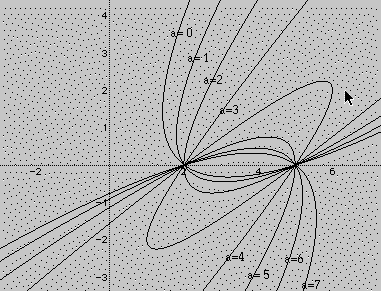
Now we can use Graphing Calculator 3.0 to graph a family of parabolas, all passing through 2 and 5 on the x-axis. The previous parabola graph was the case for a = 0.
a = 0, 1, 2, 3, 4, 5, 6, 7Perhaps some interesting additional graphs would be between a = 3 and a = 4. Here are the graphs for a = 3, 3.25, 3.5, 3.75, and 4.

The graph for a = 3.5 deserves a separate look.

As a approaches 3.5 from below, the family of parabolas all open upward and become more narrow. As A approaches 3.5 from above the parabolas all open downward and become more narrow. At a = 3.5, however, the parabola reduces to a pair of parallel lines. This indicates the equation

is factorable. We have

The graph of this relation is a pair of parallel lines. These are the lines with which we began this investigation and had we graphed a product of the two relations
y - x + 2 = 0
y - x + 5 = 0we would have obtained the union of the two individual graphs.
There are many parabolas through x = 2 and x = 5 that we have not yet examined with these equations. For example, what set of equations would generate the following graphs?

Once Again, Another Approach If we graph the product

It is clear that the graph will be the parallel lines defined by
y - x + 2 = 0
and
y - x + 5 = 0

On the other hand, the product

must also produce a pair of parallel lines when it is graphed. This is a generalized quadratic equation of the form

Examination of the generalized quadratic was once standard fare in courses on analytical geometry. Families of graphs are formed by fixing all but one of the parameters and varying the remailing one.
As long as A = 1, C = -7, and F = 10, the graph of

will cross the x-axis at 2 and 5. We know that for particular coefficients B, D, and E the resulting graphs could be conics or degenerate conics, that is, conics, circles, or parallel lines. For example, when B = -2, D = 1, and E = 0, the graph is a parabola.

When B = 0, D = 1, and E = -5, for example, the graph is a circle.
More circles.Some examples of other figures are
Hyperbolas


Two Lines
Lines and Hyperbolas
The above three graphs on the same axis shows the two hyperbolas and this pair of lines but the pair of lines can not be asymptotes to either of the hyperbolas since the graphs share the points (2,0) and (5,0).
More HyperbolasEllipses can be formed in several ways. The task here is to show sets of ellipses through the points 2 and 5 on the x-axis. The general equation is

What values of B, C, and E will give ellipses? Try C = 1 to get the coefficients of the two squared terms equal. Then try B = 1 and E = 8.

More Ellipses
What if C = 1, E is fixed, and B varies?

Here we have a rather messy collection of a circle, two ellipses, some parabolas and some hyperbolas, all crossing the x-axis at 2 and 5.
The End