Overview of Section 1.2 Congruence of Triangles
Definition of Congruent Triangles
Axiom 1.1 SAS Congruence: If two corresponding sides and the included angle of a pair of triangles are congruent, then the triangles are congruent.
N.B.: Considerable consternation has been expressed about SAS of an axiom whereas ASA and SSS are theorems. Euclid, in fact, treats all three as theorems but he relys on a proof based on superposition (moving one triangle without changing its size or shape and placing it on top of the other). But superposition is not justified in Euclids axioms (or postulates). Efforts to 'correct' Euclid have found alternative axiom systems and when we carefully develop transformational geometry, this difficulty is addressed via the concept of isometry.
Hilbert and Birkoff take SAS as an axiom and prove ASA and SSS as theorems. Some textbooks call all three of them postulates (axioms). One idea of a 'good' axiomatic system is to minimize the number of postulates (axioms) -- that is, don't assume anything that can be proved by previous axioms or theorems.
Some textbooks assume many postulates because many of the early ones are "obviously true" and tedious to prove as Theorems. That is why some school textbooks may present all of SAS, SSS, ASA, and HL as postulates. The goal is to move on to more significant theorems rather than worry about an axiomatic system with a minimal number of postulates.
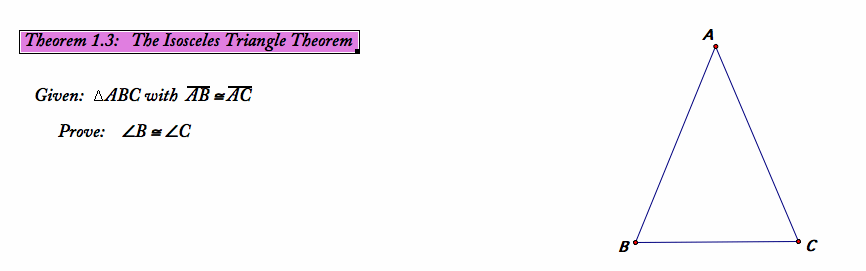
Theorem 1.3 The Isosceles Triangle Theorem and its corollary
If two sides of an isosceles triangle are congruent, then the angles opposite these sides are congruent.
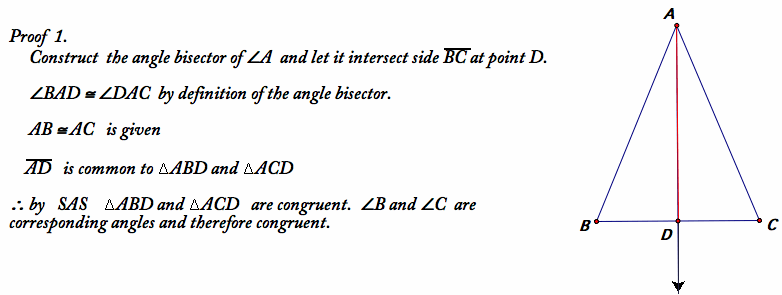
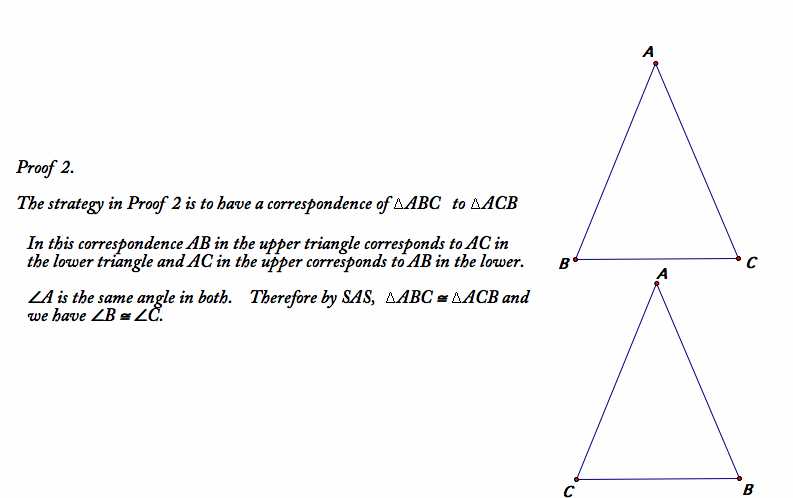
The proof plan is to find a way to incorporate SAS into the proof. This can be accomplished in different ways. Libeskind presents two usual proofs in the textbook.
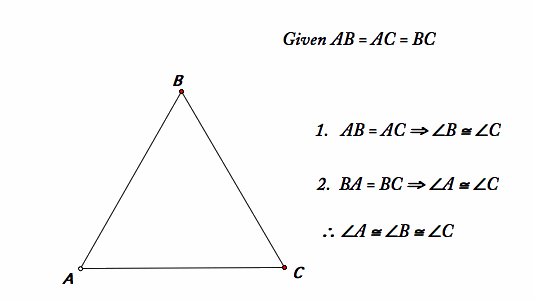
Corollary to Thm1.3: An equilateral triangle is equiangular.
The proof of this corollary follows from applying Thm 1.3 twice.
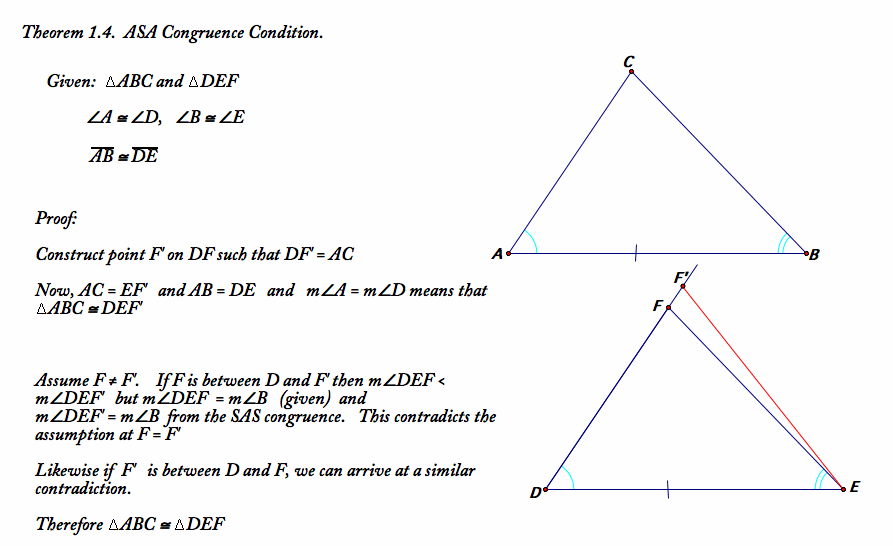
Theorem 1.4 ASA congruence condition
If two angles and the included side of a triangle are congruent to the corresponding angles and sides in a second triangle, then the two triangles are congruent.
Now Solve This 1.1
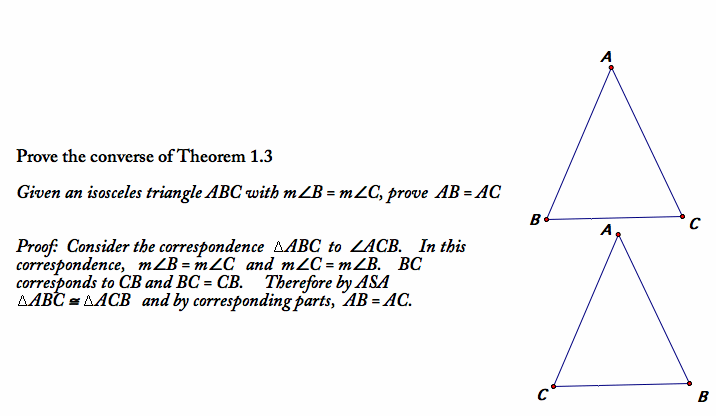
1. Prove converse of Theorem 1.3. If two angles of a triangle are congruent, then the sides opposite those angles are congruent.
In the proof of the converse of Theorem 1.3 we now have the ASA congruence as well as the SAS to use in the proof.
2. Prove an equilangular triangle is equilateral
This one is clear. Proof left to the reader.
Medians, Altitudes, Properties of Isosceles Triangles.
Now Solve This 1.2
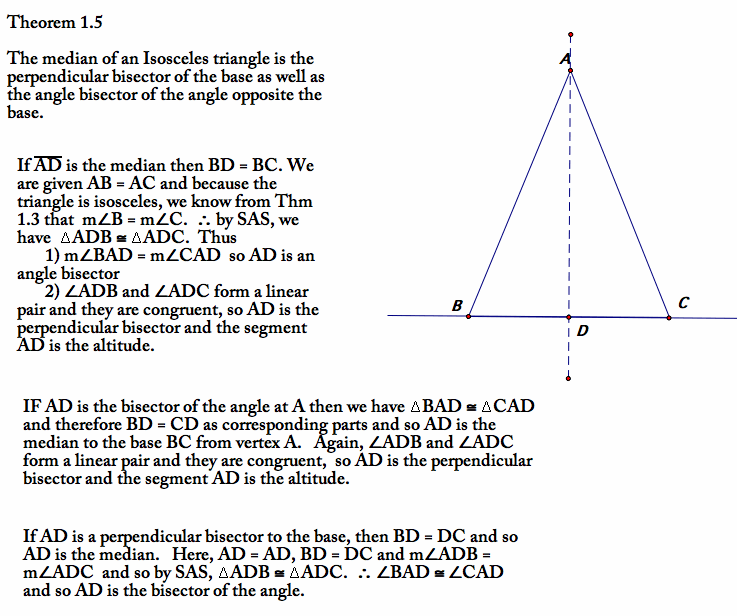
Relationship of median, altitude, angle bisector, and perpendicular bisector to base in isosceles triangles. This exploration should lead to the hypotheses that the angle bisector of the angle opposite the base will determine the median of the triangle, a line perpendicular to the base of the triangle, and the altitude of the triangle from that vertex opposite the base and all of them will lie along the same line. This is formalized in Theorem 1.5
Theorem 1.5. Median of Isosceles triangle is perpendicular bisector of base as well as the angle bisector of the angle opposite the base.
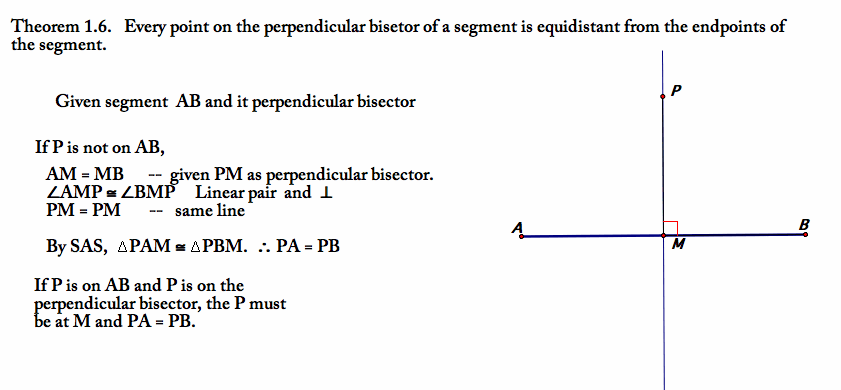
Theorem 1.6 Every point on the perpendicular bisetor of a segment is equidistant from the endpoints of the segment.
Corollary 1.2 A point is equidistant from the endpoints of a segment if and only if it is on the perpendicular bisector of the segment.
Notice this is an if and only if statement.
Corollary 1.3 If two points are equidistant from the endpoints of a segment, then the line through the points is the perpendicular bisector of the segment.
Now Solve This 1.3
Construction of perpendicular bisectors, medians, altitudes, and angle bisectors of an acute scalene triangle.
Construction of perpendicular bisectors, medians, altitudes, and angle bisectors of an obtuse scalene triangle
Euclidean Constructions: Straightedge and compass constructions (Review rules, p. 22)
Equilateral triangle given a side AB
Perpendicular bisector of a segment
Perpendicular line through a point on the line
Properties of a kite
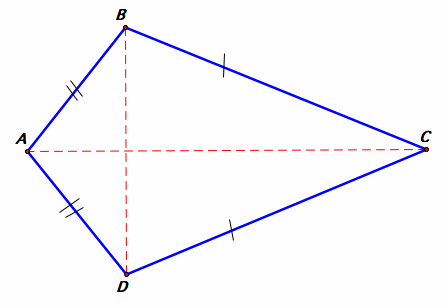
A kite is a quadrilateral that has two pairs of congruent adjacent sides; it is a quadrilateral created when two isosceles triangles share a common base. The common base is a diagonal of the kite.
Theorem 1.7. The diagonal of a kite connecting the vertices where the congruent sides intersect bisects the angles at those vertices and is the perpendicular bisector of the other diagonal.
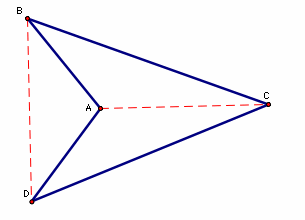
A and C are two points equidistant from the endpoints of segment AB and by Corollary 1.3, the line AC is the perpendicular bisector of AB. Then, because triangle ABD and triangle CBD are each isosceles triangles, with the common base BD, the perpendicular bisector to the base is the bisector of the vertex angle in each case.
SEE PROBLEM SET 1.2, Problem 3. This is the proof of Thm 1.7 for non-convex kites.
Rhombus -- a quadrilateral in which all four sides are congruent.
Corollary 1.4: The diagonals of a rhombus are perpendicular bisectors of each other and each bisects a pair of opposite angles.
Now Solve This 1.4
1. Converse of Corollary 1.4: A quadrilateral in which the diagonals are perpendicular bisectors of each other is a rhombus.
2. State and prove a converse of Theorem 7?
A quadrilateral in which the diagonals are perpendicular to each other is a kite.
3. Classify kite and rhombus by angle bisectors
A quadrilateral in which at least one diagonal is the angle bisector of the two opposite angles is a kite.
A quadrilateral in which the two diagonals are the angle bisectors of the opposite angles is a rhombus.
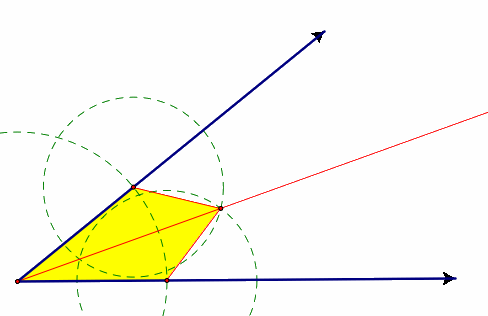
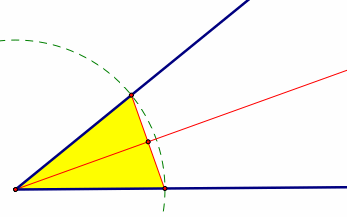
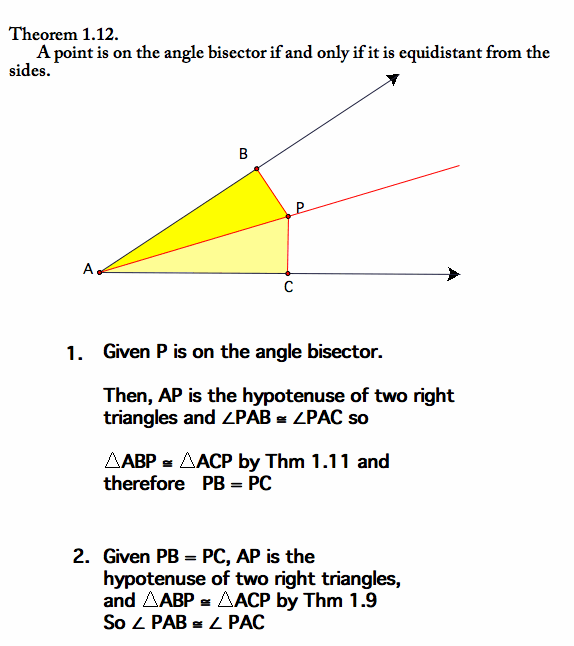
Construction: Bisect a given angle.
Using constructed kite:
Using constructed isosceles triangle:
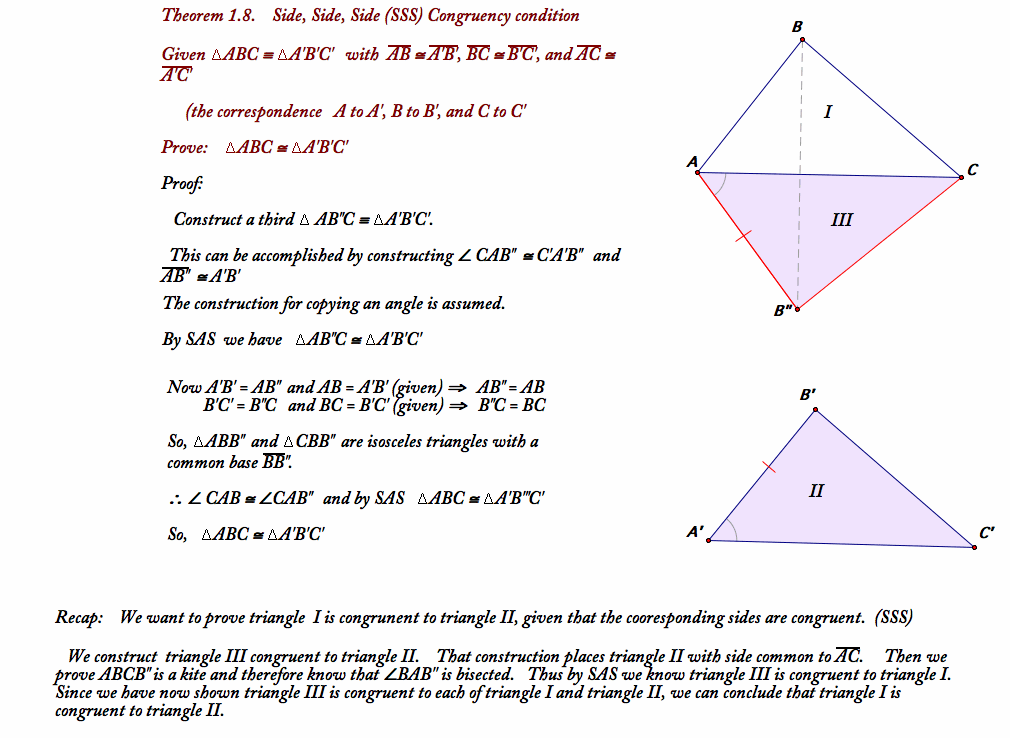
Theorem 1.8: Side, Side, Side (SSS) Congruency Condition
SEE PROBLEM SET 1.2, Problem 4.
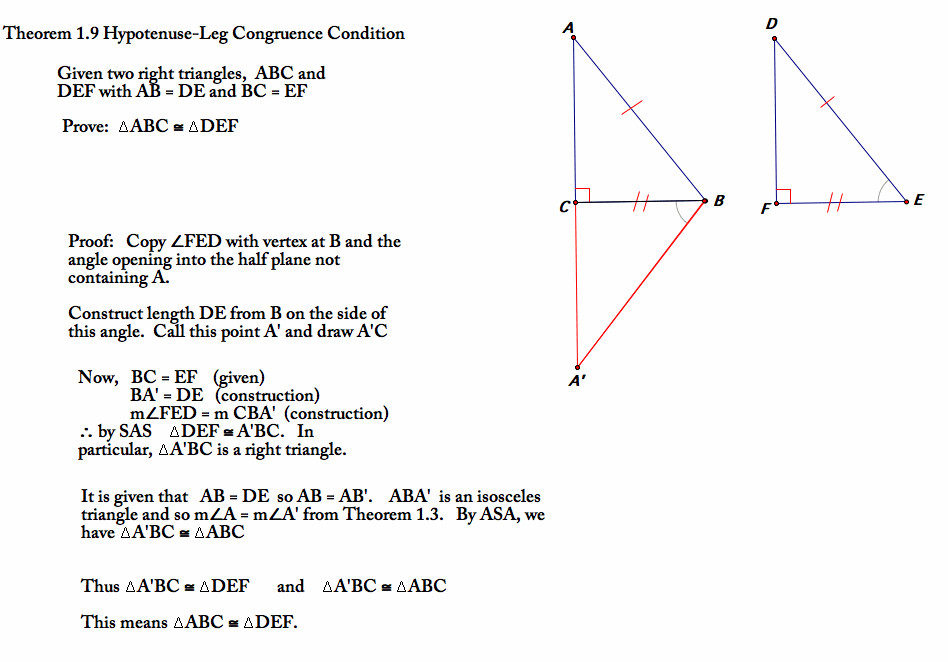
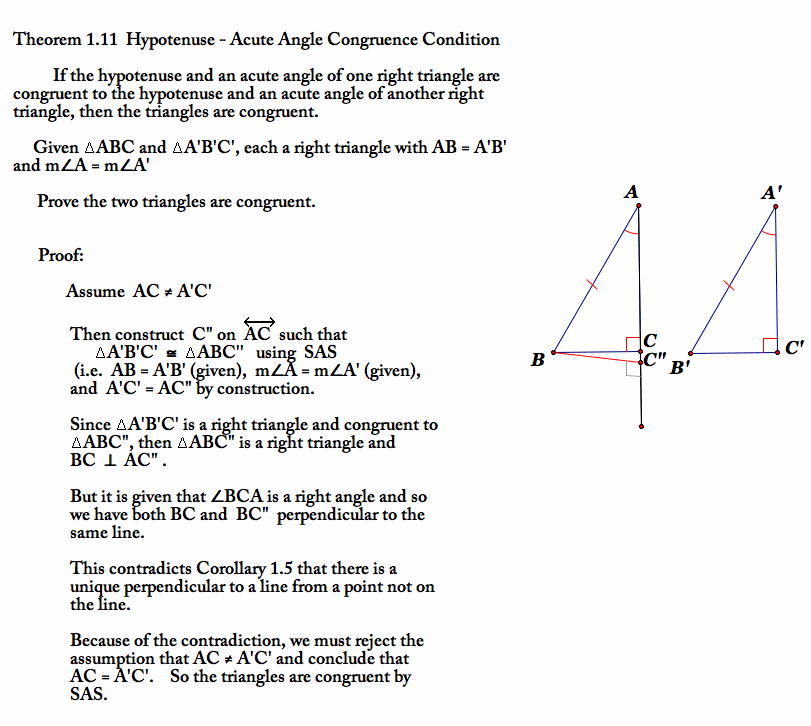
Theorem 1.9: Hypotenuse-Leg Congruence Condition
SEE PROBLEM SET 1.2, Problem 5.
Theorem 1.10: Exterior Angle Theorem
.
Now Solve This 1.5
Construction of a perpendicular to a line from a point P not on the line. This was embedded in the proof of Corollary 1.5. Note that Construction 1.3 was for the perpendicular for a point on the line. We needed the External Angle Theorem and Corollary 1.5 to justify the construction and uniqueness of this perpendicular to the line from a point not on the line.
Distance to a line -- the distance from a point P to a line l is the length of the segment connecting P with the foot of the perpendicular to l through P.
Concurrency
Three or more lines are concurrent at a point if all intersect at that point. We have MANY concurrency theorems in Geometry. For example:
The medians of a triangle are concurrent.
The perpendicular bisectors of the sides of a triangle are congruent.
The perpendicular lines from a vertex to the line of the opposite side of a triangle are concurrent.
The angle bisectors of a triangle are concurrent.
The bisectors of the two external angles at the base of a triangle and the angle bisector of the opposite angle are concurrent.
Each of these statements represents a theorem to be proved. Some of them will come up in the Problem Set. We will encounter others later in the course.
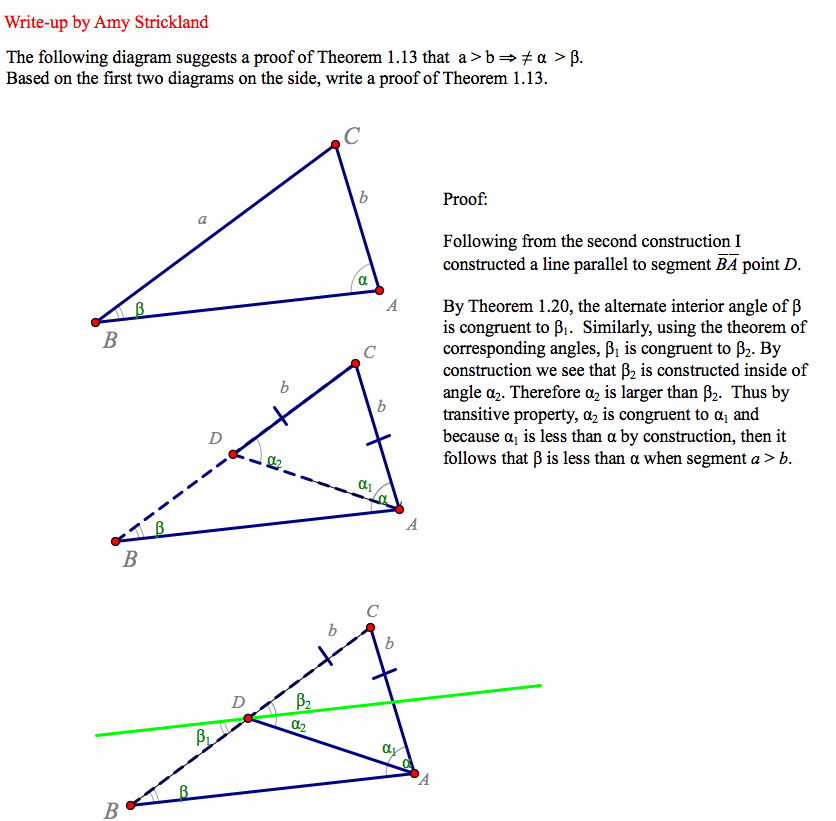
Theorem 1.14: (Converse of Theorem 1.13) Given two non-congruent angles in a triangle, the side opposite the greater angle is longer than the side opposite the smaller angle.
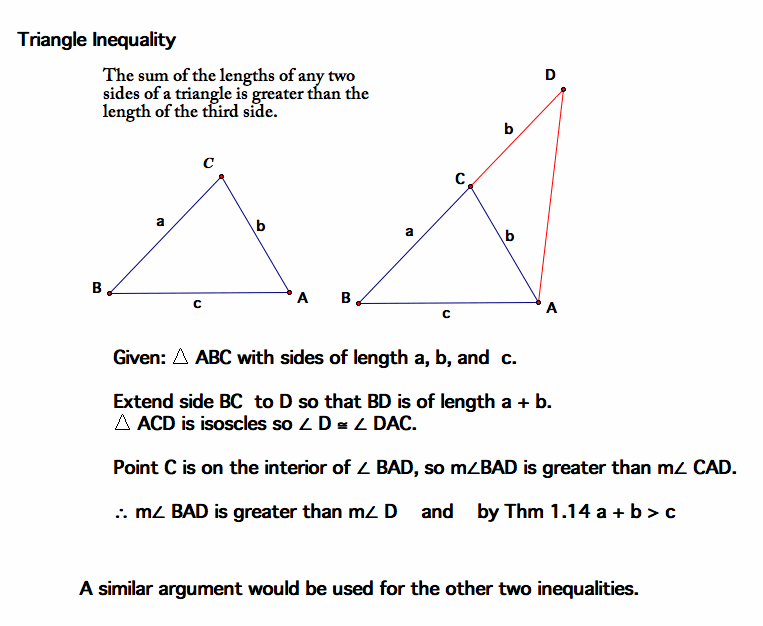
Theorem 1.15:
Now Solve This 1.6
1. Show that given three segments a, b, and c such that a + b > c, it is not always possible to whose sides are a, b, and c.
Discussion: Consider a = 10, b = 3, and c = 6.
2. Construct three segments a, b, and c so that a triangle with these segments as sides will exist. Is the existence and therefore the construction of the triangle assured by Theorem 1.15? Justify.
Hiker's Path Problem
Reflection in a line -- a reflection in a line l assigns to each point P not on the line, a point P', the image of P, in such a way that l is the perpendicular bisector of PP'. If P is on l then P' = P.
Properties of Parallel Lines
Theorem 1.16: If two lines in the same plane are each perpendicular to a third line in that plane, then they are parallel.
Prove by indirect proof: Assume the two lines are not parallel. Therefore they meet at a point P. Therefore there are two lines from P to the third line that are perpendicular. This contradicts corollary 1.5.
Transversal
Interior Angles
Corresponding Angles
Alternate Interior Angles
Alternate Exterior Angles
Theorem 1.17: If two lines are cut by a transversal and a pair of its corresponding angles is congruent (or a pair of Alternate Interior Angles are congruent), then the two lines are parallel.
Now Solve This 1.7
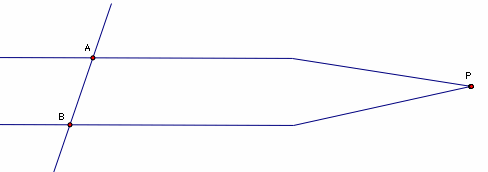
1. Prove Theorem 1.17 by contradiction. Assume lines are not parallel and therefore meet.
Now triangle PAB has an external angle congruent to an internal angle, contradicting the Exterior Angle Theorem.
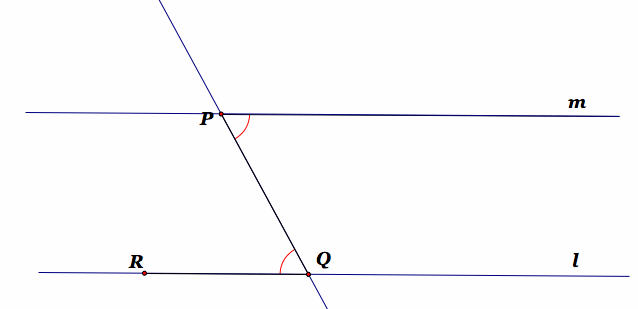
2. Construct a line through P and intersecting l at Q. Locate R on l and construct m through P by duplicating angle PQR with vertex at P and side PQ in common. This gives a pair of corresponding angles congruent and therefore l is parallel to m by Theorem 1.17.
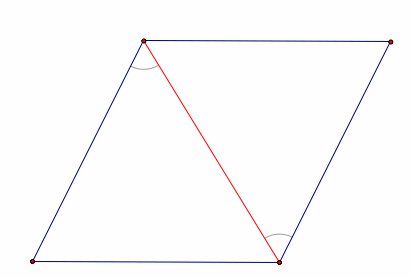
3. Prove that the opposite sides of a rhombus are parallel.
Proof: Given a rhombus, a quadrilateral with four congruent sides. Take a pair of opposite sides. By Corollary 1.4 the diagonal bisects the opposite angles. The rhombus is two isoseles triangles with common base, the diagonal. Base angles of the isoceles triangles are equal. Therefore congruent alternate interior angles exist and by Theorem 1.17 the lines are parallel.
4. Use a rhombus to solve problem 2.
Now Solve This 1.8.
Parallelogram -- a quadrilateral in which each pair of opposite sides is parallel. It is not possible to prove that the diagonals of a parallelogram bisect each other without assuming the parallel postulate.
Problem set 1.2 has 22 problems. The instruction in the text indicates the problems are to be worked without use of the parallel postulate. All of the material in this section has been structured to have a neutral geometry; all of the theorems and corollaries hold independent of the parallel postulate. So the 22 problems in Section 1.2 should only make use of undefined terms, definitions, axioms from the appendix and sections 1.1 and 1.2, and the theorems, corollaries, and Now Solve This items in sections 1.1 and 1.2.