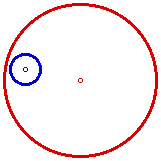
Now select a random point on the red circle and on the blue circle. Then construct a segment from the center of the blue circle to the random point on the blue circle (radius). The construct a line through the random point on the red circle and the center of the red circle.
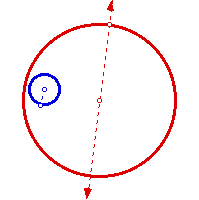
Now copy the small blue circle and make the random point on the red circle the center. Let's also name our points for ease of understanding. The random point on the red circle is now called R. The center of the red circle is now called S. Let's call the center of the blue circle B.
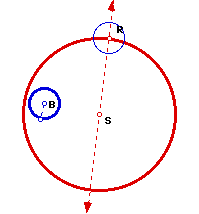
Find the points of intersection of our copied blue circle and the line SR. Then connect the point of intersection that is external to circle S to the center of circle B. Then find the midpoint of the segment RB.
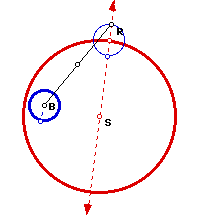
Construct the perpendicular line through the midpoint (M) of RB and perpendicular to it. Then find the point of intersection (I) of line RS and line MI.
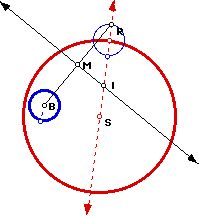
Let's clean up our sketch. You can hide the circle R, but not the point R. Now from I to R is the same distance as some point on circle B and I. So let I be the center of the circle tangent to the red circle and the blue circle. Construct this circle with center I and color it green.
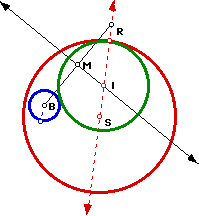
We can do a little more cleaning up. We can hide our lines and segments and any extra points, so that we only have our three circle showing.
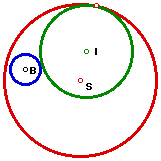
So now the green circle is internally tangent to the red circle and externally
tangent to the blue circle.
To see an animation of this in GSP, please click
here.
As the point of tangency of the green and red circles is animated around
the red circle, what do you think that the locus of points will be? Let's
look at a few still graphics and then you can make a guess.
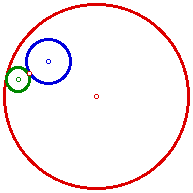
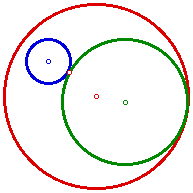
It turns out that if you trace the center of the green circle, the locus of points is an ellipse.
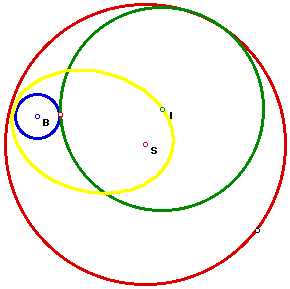
The yellow ellipse is the locus of points.
Please feel free to use this as a reference for tangent circles as needed.
I hope this will be of help to students in high school and college.