
Assignment 11
by
Johnie Forsythe
Computers allow us to make beautiful
shapes by using equations. Lets explore some polar equations to
make figure out how to construct a beautiful flower!
Lets investigate the equation:

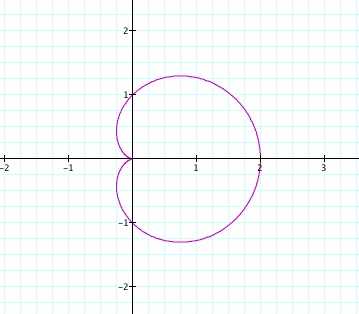 In this equation, the variables a,
b, and k are held constant or they are equal to one. Theta is
between 0 and 2.
In this equation, the variables a,
b, and k are held constant or they are equal to one. Theta is
between 0 and 2.
Let's continue to hold a and b constant,
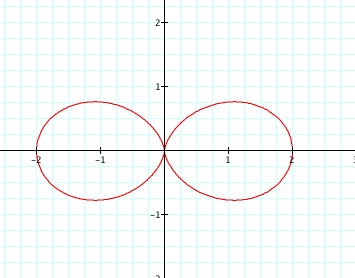
but this time....vary the values for k. We wil let k=2. This yields
the following graph:

 Observations:
When k=2, there are two leaves on
the graph.
These leaves cross the x-axis at
the origin and points (-2,0) and (2,0).
Observations:
When k=2, there are two leaves on
the graph.
These leaves cross the x-axis at
the origin and points (-2,0) and (2,0).
Continuing with our investigation......
what happens when we hold a and b constant and let k=3

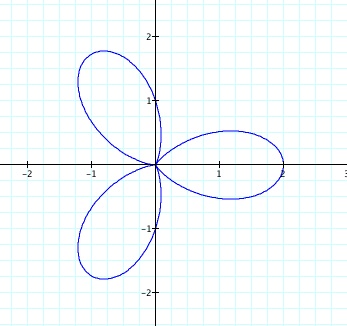 There are three leaves in this graph.
Let's try somethihng different:Let
k=1/2
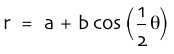
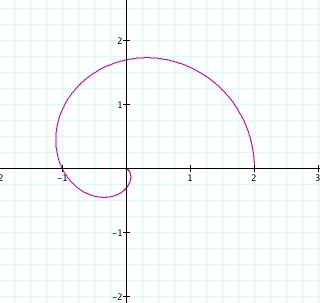 Very interesting.....the graph looks
like half of the other graph where k=1
It appears that k determines the
number of leaves for each polar equation.
Very interesting.....the graph looks
like half of the other graph where k=1
It appears that k determines the
number of leaves for each polar equation.
So, if our hypothesis is correct....then
this equation should have 10 leaves.

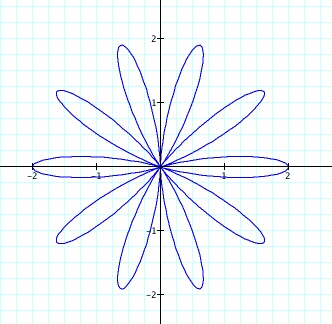 And it DOES!!!
However, just to be on the safe side....let's
graph the function when k=50.
And it DOES!!!
However, just to be on the safe side....let's
graph the function when k=50.

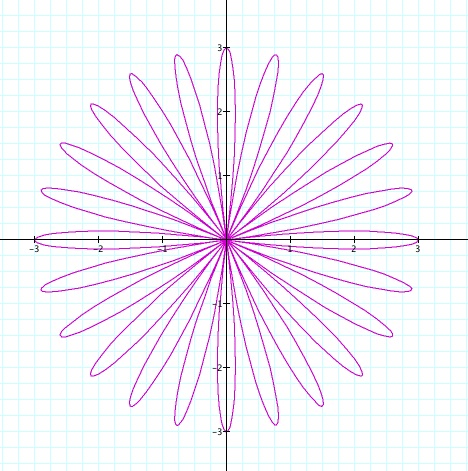
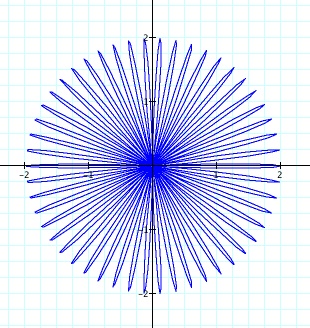 There appears to be 100 very small
leaves. Therfore, when a and b are equal, and k is an integer.
the function forms a "n-leaf rose".
There appears to be 100 very small
leaves. Therfore, when a and b are equal, and k is an integer.
the function forms a "n-leaf rose".
Now, we can investigate the polor
equation without a.
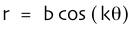 Let's look at several equations where
b is held contant at 1 and k is altered
Let's look at several equations where
b is held contant at 1 and k is altered
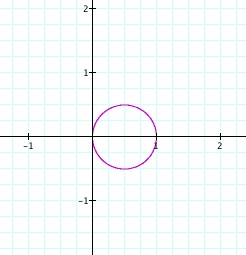 Observations:
There is one leaf.
We can possibly imply that k determines
the number of leaves for the function. Does it???
Observations:
There is one leaf.
We can possibly imply that k determines
the number of leaves for the function. Does it???
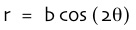
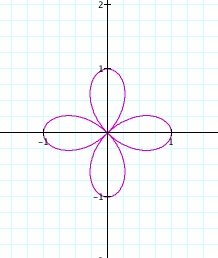 Apparantly, there are four leaves
instead of the predicted two. Why is this so?
Apparantly, there are four leaves
instead of the predicted two. Why is this so?
Let k=3:

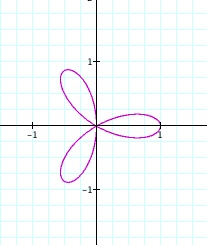 What is going on?? Our predictions
about the behavior of these polar equations are not matching up.
New hypothesis: The number of leaves
is equal to 2k for even numbers and k for odd numbers. Let's try
it!!
What is going on?? Our predictions
about the behavior of these polar equations are not matching up.
New hypothesis: The number of leaves
is equal to 2k for even numbers and k for odd numbers. Let's try
it!!

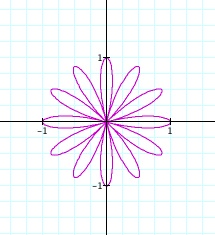 When k=6 we have an even number and
2(6)=12. This makes sense!!!
When k=6 we have an even number and
2(6)=12. This makes sense!!!
So let's set k equal to 9 and
see what we derive.

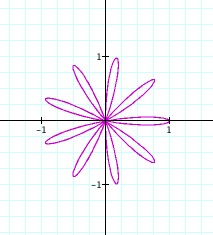 Our new hypothesis seems to hold.
Let's explore the polar equation:

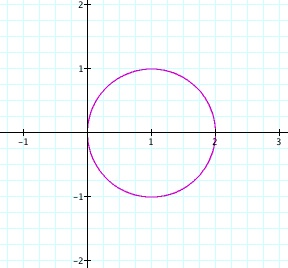 Here, k=1, a=0, and b=2. It seems
that k may equal the number of leaves again.
Here, k=1, a=0, and b=2. It seems
that k may equal the number of leaves again.
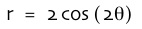
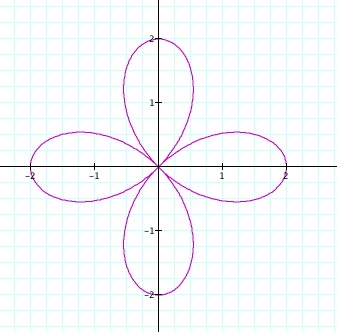 WAIT....we see here that k does not
equal the number of leaves.
WAIT....we see here that k does not
equal the number of leaves.
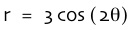
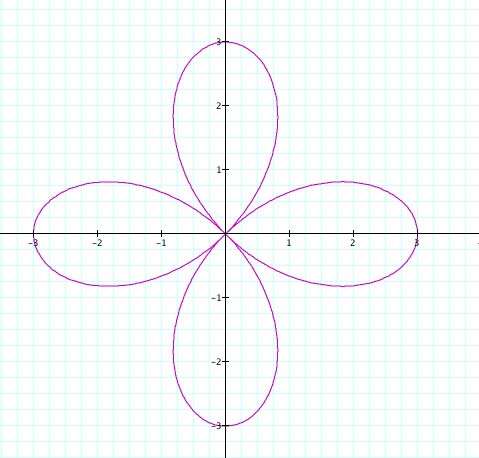 The variable b determines the radi
or length of the shape.
The variable b determines the radi
or length of the shape.
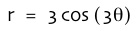
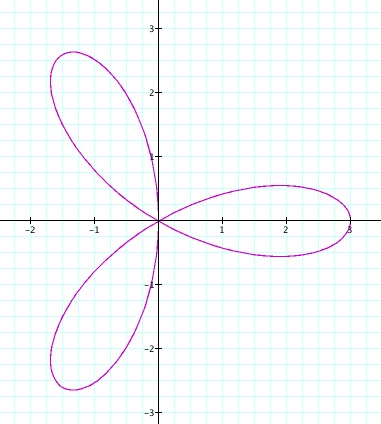 When k is even, the number of leaves
is equal to 2k. When k is odd, the number of leaves is equal to
k.
When k is even, the number of leaves
is equal to 2k. When k is odd, the number of leaves is equal to
k.
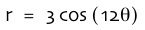
Well, as we can see.....polar equations
can become artwork. If you are aware of what causes certain trends
in mathematics, you can use mathematics to create artwork
So, how can we create a flower?

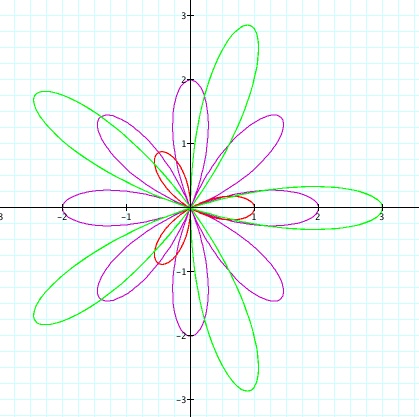 MATHEMATICALLY BEAUTIFUL!!
Back to
Johnie Forsythe's EMAT 6680 Website