
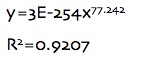
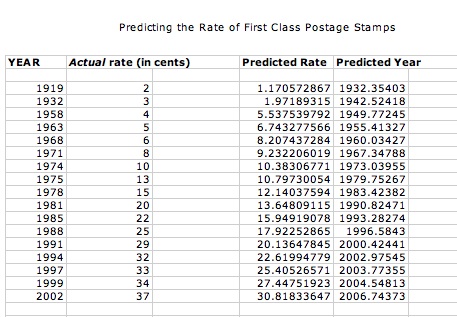
Now we can attempt to answer our initial questions:
1. When will the cost of a first class postage stamp reach $1.00?
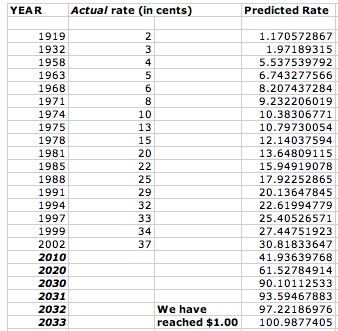 |
By the trial and error method, I inputted years into the spreadsheet to find what the predicted rate would be based on the power function. At the year 2033, the predicted rate of postage stamps would be 100.98 cents. Therefore, according to the power function, the postage stamp will reach $1.00 in the year 2033. |
2. When will the cost of a first class postage stamp be 64 cents?
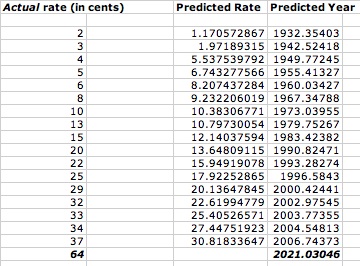 |
I inputted a rate of 64 cents into the power function which resulted in a predicted year. Therefore, based on the power function, the cost of a first class postage stamp will be 64 cents in the year 2021. |
3. How soon should we expect the next 3 cent increase?
It is difficult to say how soon we should expect the next 3 cent increase. The power function is useful to make approximate predictions. We know that the actual price of a postage stamp today is 37 cents. However, the power function yields a rate of 34 cents in the year 2005, which we know is not accurate.
If we input year values starting from 2002 to 2010, we yield a predicted rate of approximately 41 cents. We perhaps could predict that the next 3 cent increase will occur in the year 2010. Unfortunately, this truly would not be a confident statement to make, seeing that the power function is now accurate in predicting the actual rate of the postage stamp today.
Back to Johnie Forsythe's EMAT 6680 Webpage