
Bouncing
Barney
Final Assignment completed
by
Johnie Forsythe
Bouncing Barney!!
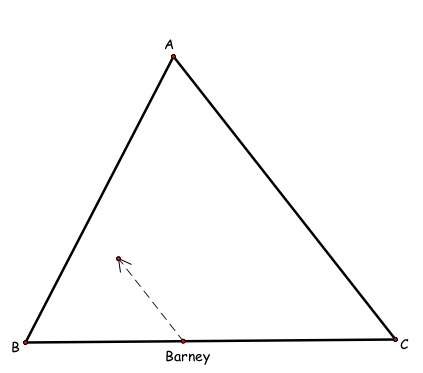
Barney is in a triangular room. He walks
from a point on segement BC parallel to segment AC. When he reaches
segment AB, he turns and walks parallel to segment BC. When he
reaches segment AC, he turns and walks parallel to segment AB.
Using GSP, we will illustrate that Barney will eventually return
to his starting point. How many times will Barney bounce off a
wall before returning to his starting point?
 Lets observe Barney's path inside
the triangle:
Lets observe Barney's path inside
the triangle:
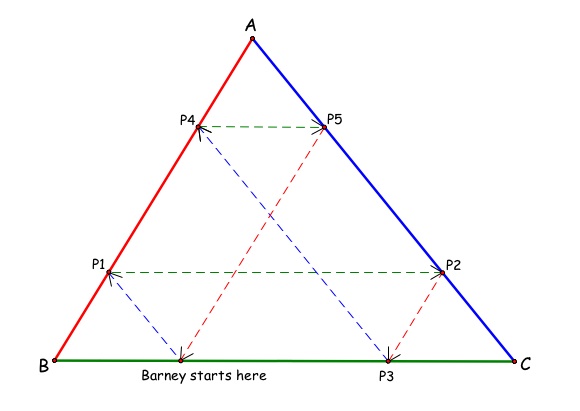 Every path that Barney moves along
is colored coordinated with the triangle sides the path is parallel
to. For example, the segment from the starting point to P1 is
parallel with segment AC, therefore they both are the same color.
We see that Barney bounces off a
wall five times before he returning to his starting point. Click
HERE to investigate Barney's path
as he moves along the segment BC. Will he always touch a wall
five times before returning to his starting point?
Now, lets explore the one of the
relationships between Barney's path and the triangular room.
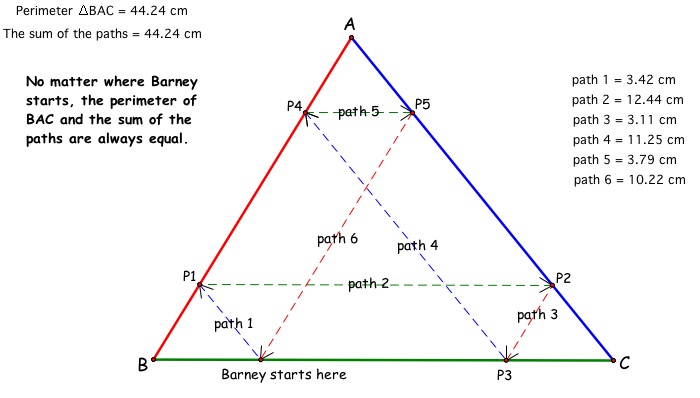
We can use GSP to find the perimeter
of the triangle ABC. Interesting........the sum of the length
of Barney's paths is equal to the perimeter of the exterior triangle!
Every path that Barney moves along
is colored coordinated with the triangle sides the path is parallel
to. For example, the segment from the starting point to P1 is
parallel with segment AC, therefore they both are the same color.
We see that Barney bounces off a
wall five times before he returning to his starting point. Click
HERE to investigate Barney's path
as he moves along the segment BC. Will he always touch a wall
five times before returning to his starting point?
Now, lets explore the one of the
relationships between Barney's path and the triangular room.
We can use GSP to find the perimeter
of the triangle ABC. Interesting........the sum of the length
of Barney's paths is equal to the perimeter of the exterior triangle!
 Will Barney return to his starting
point if he starts on a point on line BC, exterior to segment
BC?
Will Barney return to his starting
point if he starts on a point on line BC, exterior to segment
BC?
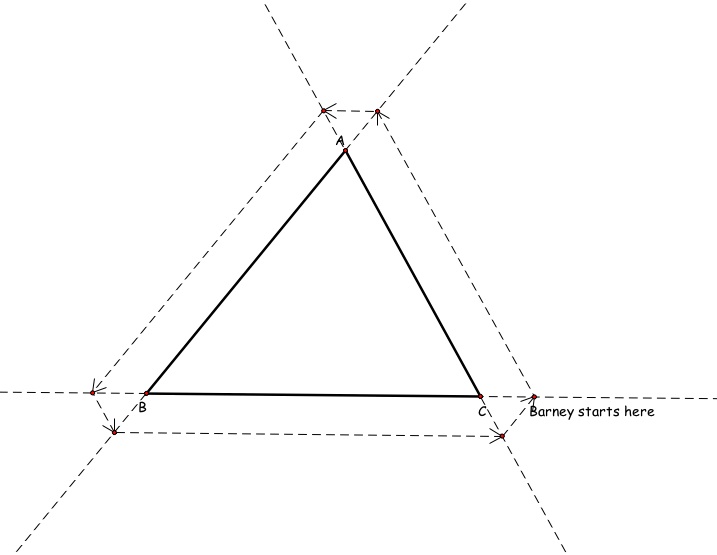 If Barney continues to follow the
rules of parallel paths, he will still return to his same starting
point after touching five points.
Let's explore more!!!
What happens if we trace the intersections
of Barney's paths?
If Barney continues to follow the
rules of parallel paths, he will still return to his same starting
point after touching five points.
Let's explore more!!!
What happens if we trace the intersections
of Barney's paths?
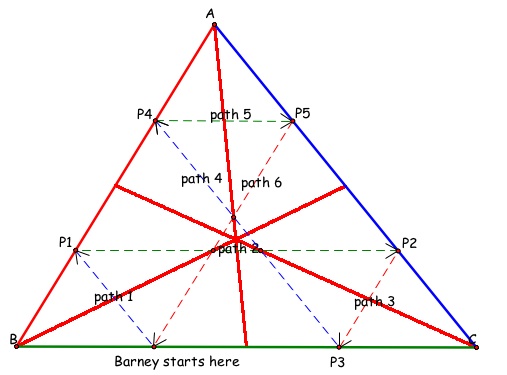 By tracing the intersections of Barney's
paths, we have constructed the medians of triangle BAC. The point
of intersection of the three medians is called the CENTROID.
One last investigation
By tracing the intersections of Barney's
paths, we have constructed the medians of triangle BAC. The point
of intersection of the three medians is called the CENTROID.
One last investigation
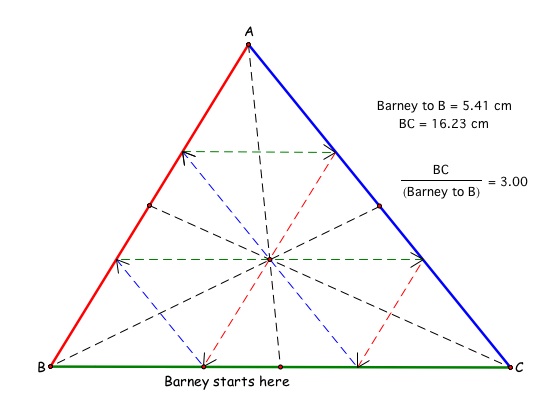 In order for Barney's paths to have
one common intersection, Barney must begin on the point
one third of the segment BC from point B. This is the only way
for the paths to all intersect at the centroid of the triangle.
In order for Barney's paths to have
one common intersection, Barney must begin on the point
one third of the segment BC from point B. This is the only way
for the paths to all intersect at the centroid of the triangle.
Back to
Johnie Forsythe's EMAT 6680 Homepage