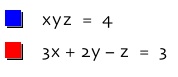
1. Find as many solutions as possible for A, B, and C that satisfy both equations:
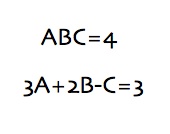
What observations can you make about your results? Again, we discussed some approaches to this one in class. Your task is to prepare a write-up that explores this task. (Not required, but you might want to consider how to explore this with a spreadsheet as well as with graphing tools.).
2. Create another set of equations that also
yield a useful exploration.
I will begin this exploration by changing the variables:
A = X
B = Y
C = Z
This does not change the equation in any
significant way.
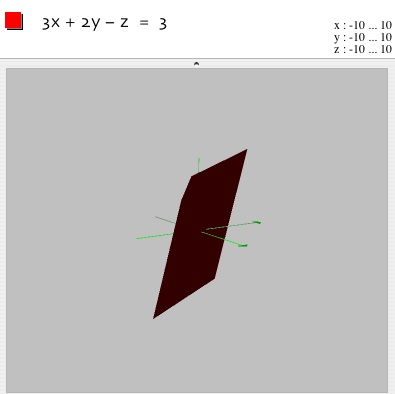
I will graph each equation using
Graphing Calculator.
 |
 |
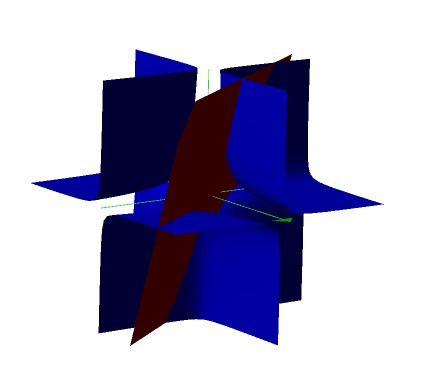
Now, let's graph this system of equations on the same coordinate plane.
|
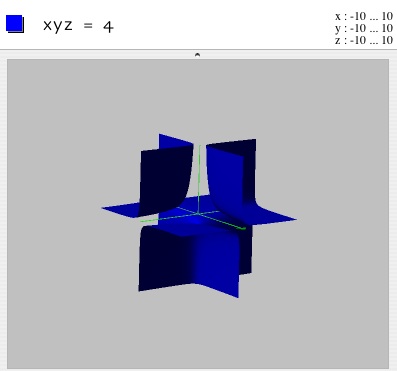
The equation xyz=4 produces a four hyperbolic shaped conics. The equation 3x+2y-z=3 produces a plane. The solutions to the system of equations are the points of intersection. |
 |
|
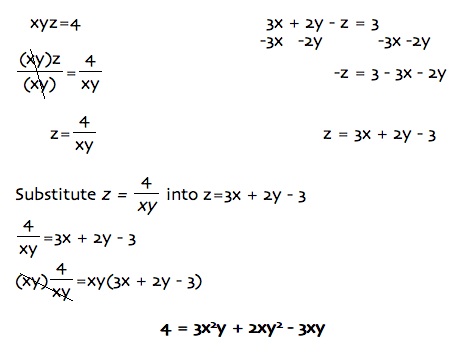
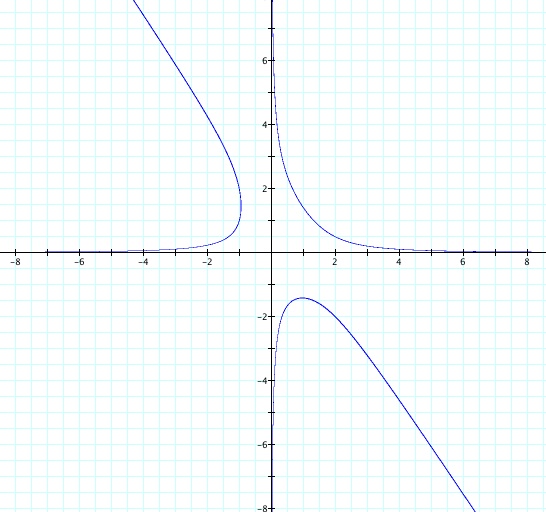
This graph represents the infinite solutions for the system of equations. We can see that there is no solution were both x and y values are less than zero (or negative). Recall the 3D graphical representation: this explains why the plane intersects only 3 out of the 4 hyperbolic shaped conics. |
 |
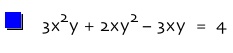
Here is another system of equations to explore:
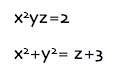
Click here to see a
3D graphical representation.
Back to Johnie Forsythe's EMAT 6680 Webpage