
Exam Question 2
On Cevians
A cevian is a line segment which goes from a vertex of
a triangle to the opposite side. Figure 13.1 shows the cevians AD, BE, and CF for the triangle ABC.
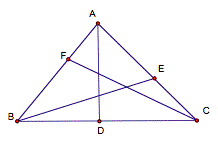
Figure 13.1
The three cevians are concurrent under certain necessary
and sufficient conditions.
To determine these conditions experimentally, let us
consider cevians which are concurrent. We know that:
(i) the
three medians of a triangle are concurrent (Figure 13.2)
(ii) the three bisectors of a triangle are concurrent
(Figure 13.3)
(iii) the three altitudes of a triangle are concurrent
(Figure 13.4)
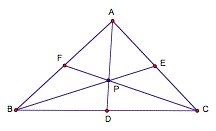
Figure 13.2
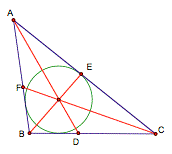
Figure 13.3
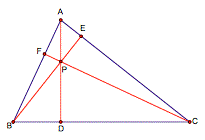
Figure 13.4
Consider
the product (AF)(BD)(EC) and (FB)(DC)(EA) in each of these triangles in Table 13.1.
|
Point of concurrence |
(AF)(BD)(EC) |
(FB)(DC)(EA) |
|
|
Centroid (Figure 13.2) |
2.46 x 3.40 x 2.31 |
2.46 x 3.40 x 2.31 |
1 |
|
Incenter (Figure 13.3) |
2.45 x 1.76 x 3.47 (14.97) |
1.70 x 2.81 x 3.14 (14.97) |
1 |
|
Orthocenter (Figure 13.4) |
1.47 x 1.85 x 5.40 (14.71) |
2.91 x 5.03 x 1.01 (14.71) |
1 |

Table 13.1
We observe that when the cevians are concurrent, the
ratio 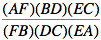 is 1. Another
way of interpreting the result in Table 13.1 is that triangles which have
concurrent cevians decompose the number 1 into two sets of three numbers whose
products are equal.
is 1. Another
way of interpreting the result in Table 13.1 is that triangles which have
concurrent cevians decompose the number 1 into two sets of three numbers whose
products are equal.
Ceva’s Theorem
This theorem states that the three cevians are
concurrent if and only if 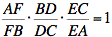 . In other words, Ceva’s Theorem states that AD, BE, and CF
concur if and only if the product of the ratios into which the sides are
divided by D, E, and F is
1. A proof of the theorem is presented below.
. In other words, Ceva’s Theorem states that AD, BE, and CF
concur if and only if the product of the ratios into which the sides are
divided by D, E, and F is
1. A proof of the theorem is presented below.
Consider triangle ABC and its concurrent cevians in Figure 13.5. Let h1 and h2 be the perpendiculars from P to BC and from A to BC, respectively.
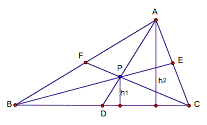
Figure 13.5
Triangles
BPD and CPD have the same height h1.
Area
of ∆BPD = ½ BD x h1.
Area
of ∆CPD = ½ DC x h1.
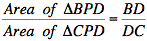 (1)
(1)
Further,
triangles ABD and ADC have the same height h2.
Area
of ∆ABD = ½ BD x h2.
Area
of ∆ADC = ½ DC x h2.
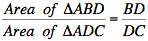 (2)
(2)
From
(1) and (2),
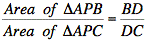 (3)
(3)
Similarly,
if we start with the side AB, we
have
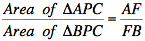 (4)
(4)
And,
if we start with side AC, we have
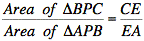 (5)
(5)
Multiplying
(3), (4) and (5), we have
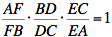
Now,
we prove the converse of the theorem. We assume that
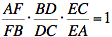 (6)
(6)
and
prove concurrency. Let the segments BE and CF intersect at P in Figure 13.6. Let AP meet BC
at some point D’. We
prove that D’ = D.
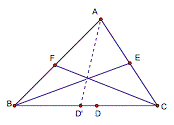
Figure 13.6
By
Ceva’s theorem,
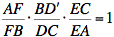 (7)
(7)
From
(6) and (7),

Therefore,
D and D’ are one and the same point.
Among
various applications, the Ceva’s theorem can be used to prove concurrency. For
instance, we apply the theorem to show that the three medians of a triangle are
concurrent. In Figure 13.7, D, E and F
are the midpoints. Therefore,  ,
,  , and
, and  and
and 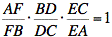 .
.
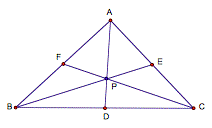
Figure 13.7
Similarly,
we can show that the angle bisectors are concurrent. Figure 13.8 shows the
bisectors AD, BE, and CF of angles A,
B, and C, respectively.
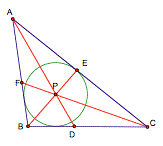
Figure 13.8
Since
AD is the bisector of angle A,  (Click HERE for Proof). Similarly, the bisectors BE and CF give
  and
and  . Thus,

which
shows that Ceva’s theorem is satisfied.
Now,
we apply Ceva’s theorem to show that the altitudes of a triangle are concurrent
(Figure 13.9).
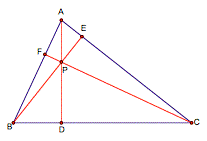
Figure 13.9
Since
∆ CAF is similar to ∆ BAE, we have 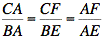 .
.
Since
∆ ABD is similar to ∆ CBF, we have 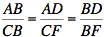 .
.
Since
∆ ACD is similar to ∆ BCE, we have 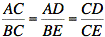 .
.
 .
.
Further
exploration
In
all the above experiments, the intersections of the cevians (P) was considered to be inside the triangle. In these
cases, the ratios  , and
, and  are all positive.
Now,
the point P is chosen to be
outside the triangle ABC (Figure
13.10). We observe that two of the vertices of the cevian triangle are outside.
Thus, two of the ratios are negative.
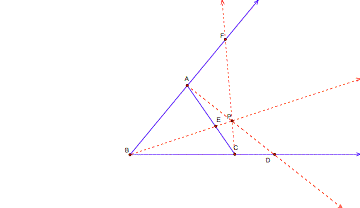
Click
HERE to explore the location of the cevian
triangle as P moves in different
locations.
Illustrative
example
In
Figure 13.11, AF = 1, AB = 3, CD = 1, CE = 2, EA = 2. Calculate BC.
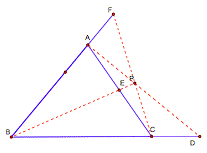
Figure 13.11
By
Ceva’s Theorem
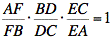
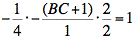
This
gives  .
.
When
P is on one of the sides of the triangle
ABC, the three vertices of the
cevian triangle are aligned along the side (degenerate case).
14 December 2006
Ajay Ramful