
Exam Question 1
Bouncing Barney
Problem
statement
Barney is in the triangular room shown in Figure 14.1.
He walks from a point on BC parallel to AC. When he reaches AB, he turns and
walks parallel to BC. When he reaches AC, he turns and walks parallel to AB.
Prove that Barney will eventually return to his starting point. How many times will Barney reach a wall
before returning to his starting point? Explore and discuss for various
starting points on line BC, including points exterior to segment BC. Discuss
and prove any mathematical conjectures you find in the situation.
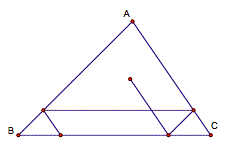
Figure 14.1
Barney can start at any point along the segment BC. We
denote the starting point by .
.
Figure 14.2 shows the positions of Barney as he moves
from one side of the triangle to the other according to the rule specified in
the problem until he reaches the point where he started. The different
positions are denoted by  and
and  . Thus, we observe that Barney makes 5 bounces (6 segments)
to come to its starting point.
. Thus, we observe that Barney makes 5 bounces (6 segments)
to come to its starting point.
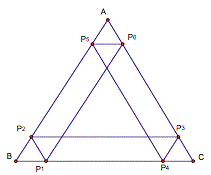
Figure 14.2
We
consider two particular cases:
(i) 
(ii)

Case (i)
Figure
14.3 shows the scenario when the starting point of Barney is at the first third
of BC. We observe that there are nine congruent triangles. This can easily be
verified by letting angle  to be x and
  to be y and applying corresponding and alternate angle
properties on the parallel lines.
to be y and applying corresponding and alternate angle
properties on the parallel lines.
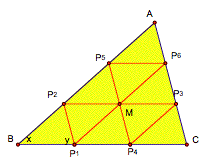
Figure 14.3
The
perimeter of the path  to
to  is equal to the
perimeter of the triangle ABC. We
shall prove this at a later point. Further,
is equal to the
perimeter of the triangle ABC. We
shall prove this at a later point. Further,  ,
, and
and  lie on the
vertices of a hexagon whose centre is the centroid of triangle ABC. Moreover, the area of the hexagon
lie on the
vertices of a hexagon whose centre is the centroid of triangle ABC. Moreover, the area of the hexagon 


 is 2/3 the area
of the triangle ABC.
is 2/3 the area
of the triangle ABC.
Case (ii)
Now
we consider the case when Barney is midway along BC. The path is illustrated in
Figure 14.4. Here, the trajectory of Barney is the medial triangle. We have 4
congruent triangles and the path consists of only three segments. Therefore,
the ratio of the area of the medial triangle to the original triangle is 1: 4.
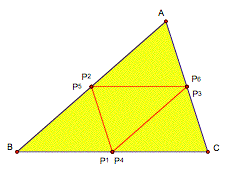
Figure 14.4
We
show that the six triangles  in Figure 14.4b
are congruent.
in Figure 14.4b
are congruent.
From
the parallelograms  and
and  , we have
  .
.
From
the parallelogram  and
and  , we have
  .
.
Also,
all the six triangles have same angles x, y, and z. Hence, applying the SAS property, the 6 triangles
are congruent.
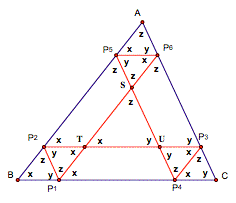
Figure 14.4b
In
fact, Barney returns to his initial point after  . This can be seen from Figure 14.4b. Since
  is a parallelogram, the length of
  is equal to
  . Also,
  is parallel to AB. If Barney does not return to his initial position
after
is parallel to AB. If Barney does not return to his initial position
after  then this will
violate the condition that motion is parallel to side of triangle.
then this will
violate the condition that motion is parallel to side of triangle.
The
scenario when the starting point of Barney is exterior to the triangle ABC is shown in Figure 14.5.
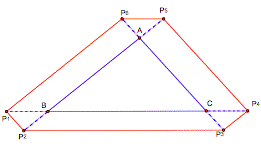
Figure 14.5
Once
again the points ,
, ,
, ,
, ,
, , and
, and  lie on a hexagon
but here it is outside the triangle.
lie on a hexagon
but here it is outside the triangle.
Click
HERE for animation
All
the triangles that are generated as P1
moves exterior to BC are similar
to the original triangle ABC. As P1 moves to the left of BC, the triangles are inverted and as P1 moves to the right of BC, the orientation is maintained.
Let
the heights of similar triangles ABC
and  be h1 and h2 respectively in Figure 14.6.
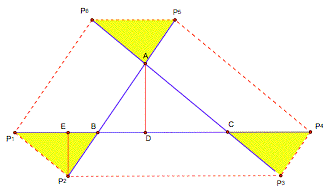
Figure 14.6
 or
or 
Note
 is a constant as
it is the ratio of the height to the base of triangle ABC.
is a constant as
it is the ratio of the height to the base of triangle ABC.
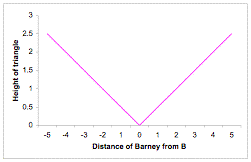
In
Figure 14.6,  represents the
distance between the starting point
represents the
distance between the starting point  and vertex B. A plot of
  against
  is shown in
Figure 14.7, where
is shown in
Figure 14.7, where  . The origin has
been made to coincide with the point B. When Barney moves to the left of B, this is considered as negative
direction and when he moves to the right this is regarded as positive
direction. Moreover, when Barney is at the midpoint of BC,
. The origin has
been made to coincide with the point B. When Barney moves to the left of B, this is considered as negative
direction and when he moves to the right this is regarded as positive
direction. Moreover, when Barney is at the midpoint of BC,  .
.
It
should be noted that if Barney starts at one of the vertices of the triangle
then the path that it traces is the triangle itself.
An
interesting ratio involving  ,
, ,
, ,
, ,
, , and
, and  in the Bouncing
Barney problem is
in the Bouncing
Barney problem is

or  .
.
This
ratio has been derived on the basis of numerical experiments and is yet to be
proved. When Barney is at B, this
ratio is 0 and when he is at the midpoint of BC it is 1.
Some
results and proofs
Result
1:
We
prove that the perimeter of the path is equal to the perimeter of the triangle
ABC. Consider Figure 14.8 with the dimensions shown.
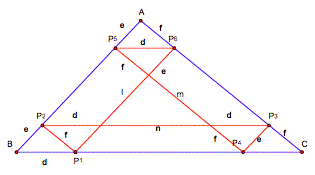
Perimeter
of path = 
=

=

=

Perimeter
of  =
= 
= 
= 
When
 is at the
midpoint,
is at the
midpoint, ,
,  , and
, and  ,
,
 ,
,  , and
, and  .
.
Perimeter
of  =
= 
=
= 2 x length of path
The
calculation of the perimeter of the path when the starting point is outside
triangle ABC is shown in Figure
14.9.
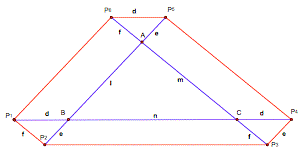
Perimeter
of path = 
= 
=

Sum
of long segments = 
= 
Sum
of short segments = 
Perimeter
of  =
= 
Result
2
1.
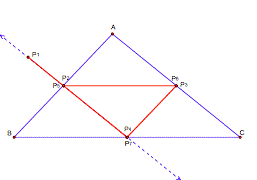
The path of Barney
corresponds to the medial triangle not only when  is at the
midpoint of BC but for any point on the line which passes through the
midpoint of BC and AB (Figure 14.10).
is at the
midpoint of BC but for any point on the line which passes through the
midpoint of BC and AB (Figure 14.10).
2.
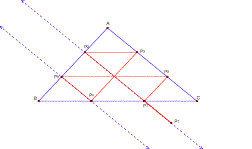
Similarly, nine
congruent triangles are obtained not only when  is at the points
of trisection of BC or when
is at the points
of trisection of BC or when  is at the
centroid. Any points on the lines which passes through the points of trisection
as shown in Figure 14.10b equally yield 9 congruent triangles.
is at the
centroid. Any points on the lines which passes through the points of trisection
as shown in Figure 14.10b equally yield 9 congruent triangles.
3.
Now we prove that if the
center triangle is congruent to the triangles created by the path, then the
sides are met at quarter points.
Let the
height of the congruent triangles be  in Figure 14.11.
Therefore, the height of triangle ABC
is 4h as it consists of 4
congruent triangles arranged vertically.
in Figure 14.11.
Therefore, the height of triangle ABC
is 4h as it consists of 4
congruent triangles arranged vertically.
Triangle ABC is similar to triangle  . Therefore,
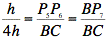
In
other words,  . Similarly, it can be shown that
  , and
, and  .
.
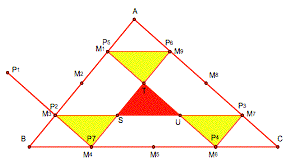
Figure 14.11
 to
to  denote the
quarter points along AB, BC, and CA in Figure 14.11.
denote the
quarter points along AB, BC, and CA in Figure 14.11.
12 December 2006
Ajay Ramful