
Assignment 10
Cycloid
A
cycloid is the locus of a point on the rim of a circle that rolls along a line.
Let P be a point on the rim of the circle with centre C and radius r in Figure 10.1.
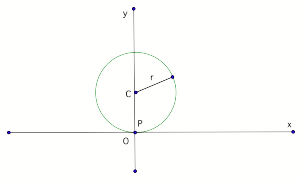
Figure 10.1
Assume
that P is initially at the origin.
Let the circle roll along the x-axis as shown in Figure 10.2. Let the new point
of contact with the x-axis be denoted by T.
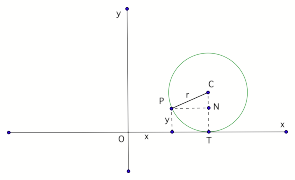
Figure 10.2
The
length of arc PT is equal to the
length of OT. Let  denotes the
angle between CP and CT.
denotes the
angle between CP and CT.
Length
of arc  and thus
  .
.
 and
and  .
.
Thus,
the coordinates of P relative to
the x- and y- axis is
 and
and  or the
parametric equations of the cycloid are
or the
parametric equations of the cycloid are


The
curve generated by this pair of parametric equations is called the cycloid. Its
Cartesian equation is given by
 .
.
When the circle makes one complete rotation, the point
P is back on the x-axis and  makes an angle
of
makes an angle
of  . Thus, one complete arc of a cycloid is generated when
  varies from 0 to
  . The
maximum point on the cycloid corresponds to the diameter of the circle (2r). Its period corresponds to the circumference of the
circle, i.e.,
. The
maximum point on the cycloid corresponds to the diameter of the circle (2r). Its period corresponds to the circumference of the
circle, i.e.,  .
.
Figure 10.3 shows a plot of cycloids for circles of
radii one, two and three units, where  varies from 0 to
  .
.
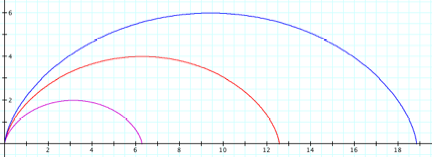
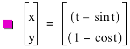
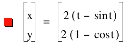
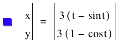
Figure 10.3
Observe,
the maximum height progresses from 2 to 6 units while the period changes from  to
to  .
.
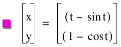
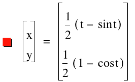
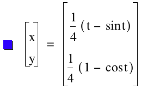
Figure
10.4 shows the cycloids generated when the radii of the unit circle is reduced
to  and
and  .
.
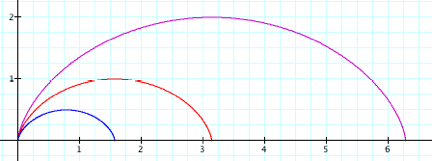
Figure 10.4
Construction
of a cycloid with GSP
In
GSP, a cycloid can be generated by making the centre of the circle in Figure
10.1 move along the line passing through it parallel to the x-axis and rotating
the point P clockwise.
Click HERE for an animation
If
instead of rolling along a straight line in Figure 10.1, the circle rolls
externally on the circumference of a fixed circle, any point P on the
circumference of the rolling circle describes a locus called an epicycloid.
Figure 10.6 shows an epicycloid, where the fixed circle has radius 4 units and
the moving circle has radius 1 unit. Its parametric equations are given by

 ,
,
where
a and b (=a/4) are
the radii of the fixed circle and the rolling circle respectively.
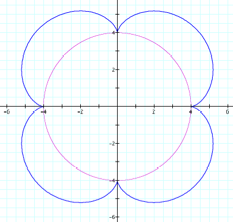
Figure 10.6
Click HERE for an animation
We
can also trace the locus of a point on a circle which rolls inside the
circumference of a fixed circle  . The locus is
called a hypocycloid. Its parametric equations are given by
. The locus is
called a hypocycloid. Its parametric equations are given by


As
an illustrative example, we choose the radius of the moving circle as being one
quarter of the radius of the fixed circle. Figure 10.7 shows a plot of the
parametric equations for  .
.
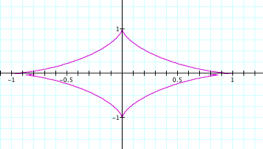
Figure 10.7
Click HERE for an animation
Reference
Thomas, G.B & Finney, R.L. (1986). Calculus and
analytic geometry (6th Edition).
Reading: Addison-Wesley Publishing Company.
17 November 2006
Ajay Ramful