
Assignment 4
On concurrency
The
mid-point and intercept theorem are first stated as they are used in proving
concurrency of medians.
The
Mid-point Theorem
The straight line joining the mid-points of two sides
of a triangle is parallel to the third side and equal to half of it.
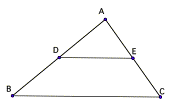
Figure 4.1
In
Figure 4.1, DE is parallel to BC and DE = ½ BC.
The
Intercept Theorem
The straight line drawn through the middle point of
one side of a triangle parallel to another side bisects the third side.
In Figure 4.1, AE = EC.
The
Centroid Theorem
(i)
The three medians of a
triangle are concurrent.
(ii)
The points at which the
medians intersect is one third of the way along each median, measured towards
the vertex.
Note: The straight line joining any vertex of a
triangle to the midpoint of the opposite side is called the median.
The
coordinates of the centroid are given by
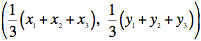 .
.
Proof:
(i)
Consider triangle ABC in Figure 4.2. Let the midpoints of AB and AC be F and E
respectively. BE and FC intersects at G.
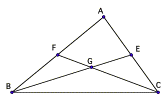
Figure 4.2
We
show that the line segment from A to the midpoint of BC (call it D) passes
through G. In other words, we show that the three medians are concurrent.
Produce
AG to H so that AG = GH as shown in Figure 4.3.
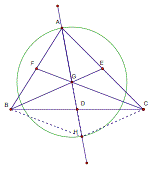
Figure 4.3
Consider the triangle ABH. Since F and G are
midpoints, FG is parallel to BH from the Midpoint Theorem. Similarly, consider
the triangle ACH. Since E and G are midpoints, GE is parallel HC. Therefore,
BGCH is a parallelogram. Hence, the diagonals BC and GH bisects each other or
AH bisects BC at the midpoint D. Thus, the third median AD also passes through
G.
(ii)
Now, we prove DG = 1/3 DA, FG = 1/3 FC and EG = 1/3 EB.
In
the parallelogram BGCH, GD = ½ GH and GH = AG. Thus, GD = ½ AG or
AG : GD = 2 : 1 or DG = 1/3 DA. Similarly, we can prove that FG = 1/3 FC and EG
= 1/3 EB.
Click
HERE to have a script tool for constructing the
centroid of a triangle.
The
Circumcenter Theorem
The
perpendicular bisectors of the three sides of a triangle are concurrent.
Proof:
Consider
the triangle ABC and let the perpendicular bisectors from AB, BC and CA be
denoted by MZ, NX and PY as shown in Figure 4.4.
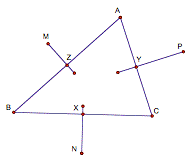
Figure 4.4
We
show that MZ, PY and NX intersect at the common point (call it O). We start
with two perpendicular bisectors, say MZ and PY and show that NX also passes
through the point of intersection at O.
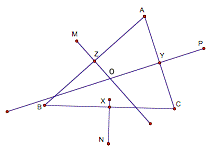
Figure 4.5
Since
O lies on the perpendicular bisector of AB, AO = OB. Similarly, since O lies on
the perpendicular bisector of AC, AO = OC. Thus, AO = OB = OC. In other words,
O lies on the perpendicular bisector of BC. Thus, the three perpendicular
bisectors intersect at the common point O, called the circumcentre. The point O
is equidistant from A, B and C. The circle drawn from point O containing A, B
and C is called the circumcircle and OA, OB or OC is called the circumradius
(Figure 4.6).
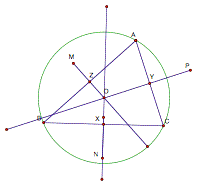
Figure 4.6
The
position of the circumcentre depends of the type of triangle. For an
acute-angled triangle, the circumcentre lies inside the triangle. For an obtuse-angled triangle, the
circumcentre lies outside of the triangle and for a right-angled triangle, the
circumcentre is on one of the sides. Finally, for an equilateral triangle, the
centroid corresponds to the circumcentre as angle bisectors passes through
midpoints of sides.
Click
HERE to have a script tool for constructing the
circumcentre of a triangle.
The
Orthocentre Theorem
The altitudes of a triangle are concurrent.
Proof:
The proof for concurrency uses the same principle as
those of the above theorems i.e., we start with two of the altitudes and show
that the third one passes through the point of intersection. Let the three altitudes of the triangle
ABC be AX, BY and CZ . We start with BY and CZ and show that AX also passes
through the common point H.
Through A, B and C draw lines parallel to the BC, AC
and AB respectively as shown in Figure 4.7 to form triangle MNP.
We
apply the Circumcentre Theorem on triangle MNP to show that the altitudes AX, BY
and CZ are concurrent. BC is
parallel to MA and AC is parallel to MB. Therefore MACB is a parallelogram and
|BC| = |MA|. Similarly, BANC is a parallelogram, |BC| = |AN|. Thus, |MA| =
|AN|. The altitude AX is perpendicular to BC by definition. BC is also parallel
to MN. Thus, AX is the perpendicular bisector of MN. In a similar way, BY and
CZ are perpendicular bisectors of MP and NP. Applying the Circumcentre Theorem,
we conclude that three altitudes are concurrent.
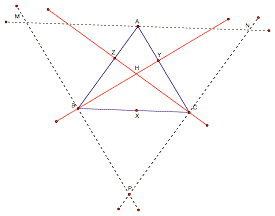
Figure 4.7
The
position of the orthocentre (H) depends on whether the triangle is acute,
obtuse or right angle. The scrip tool developed in assignment 5 allows us to
look at the different situations.
Click
HERE to have a script tool for constructing the orthocentre
of a triangle.
The
In-centre Theorem
The
internal bisectors of the three angles of a triangle are concurrent.
Proof:
Consider
triangle ABC and the internal bisectors AX, BY and CZ of angles A, B and C
respectively. Figure 4.8 shows triangle ABC with the bisectors AX and BY
intersecting at I. We show that CZ also passes through I.
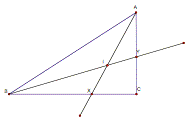
Figure 4.8
Now
we construct perpendiculars IP, IQ and IR from I to the sides BC, AC and AB
respectively in Figure 4.9.
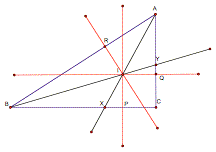
Figure 4.9
Since I is on the bisector of angle B, I is
equidistant from the sides BA and BC. Therefore, IP = IR. Also, I is on the
bisector of angle A. Thus, I is equidistant from the sides AB and AC and IR =
IQ. We conclude that IP = IQ. I is equidistant from the sides AC and CB. In
other words, I is on the bisector of angle C. In addition, IP = IQ = IR.
Therefore, the three bisectors are concurrent. We can construct the inscribed
circle with center I and radius IP,
IQ or IR called the in-radius.
Whatever be the nature of the triangle, the in-centre I is always inside the
triangle.
Click
HERE to have a script tool for constructing the
in-centre of a triangle.
The
relationship between the Centroid (G),
Orthocenter (H), Circumcenter (O) and Incenter (I) can be observed from the
following script tool: TRIANGLE CENTERS
Key:
Centroid (G) 
Orthocenter
(H)

Circumcenter (O) 
Incentre (I)

Reference: Durell, C.V. (1965). A New Geometry. London: G. Bell and Sons
Ajay Ramful
22 October 2006