
Assignment 6
Common Tangents To Two Circles
Exterior common tangents
Consider two circles C1 and C2
with centers O1 and O2 and radii r1 and r2
respectively. Without loss of generality we assume that r1 > r2.
Further, we assume that the two circles do not intersect as shown in Figure
6.1.
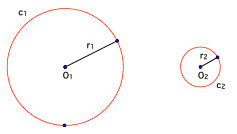
Figure 6.1
The construction of the two exterior common tangents
is shown in Steps 1 to 5.
STEP 1:
Draw a circle centered at O1 with radius r1 – r2.
STEP
2: Using the procedure for
constructing a tangent from a point outside the circle, construct tangents O2A
and O2A` as shown in Figure 6.2.
STEP
3: Join O1A and O1A`
and produce to cut circle  at B and B`.
STEP 4:
Through O2 draw O2D and O2D` parallel to O1B
and O1B` respectively.
STEP 5:
Join BD and B`D` to obtain the two exterior common tangents.
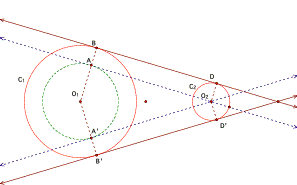
Figure 6.2
Click HERE for a script tool to construct exterior tangents.
Interior common tangents
The
construction of the two interior common tangents to the two circles in Figure
6.1 is illustrated below.
STEP 1: Draw a circle with center O1 and
radius r1+r2.
STEP 2: Construct tangents O2A and O2A`
as shown in Figure 6.3.
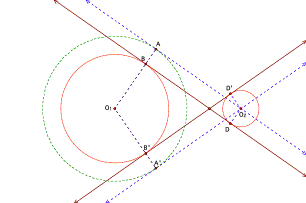
Figure 6.3
STEP 3: Join O1A and O1A`.
Denote the points of intersection of line segments O1A and O1A`
and circle center O1 as B and B` respectively.
STEP 4: Through O2 draw O2D and
O2D` parallel to O1B and O1B` respectively.
STEP 5: Join BD and B`D` to obtain the interior common
tangents.
Click
HERE for a script tool to construct common
interior tangents.
Now we determine the equation of the four tangents.
Let P1 and P2 be the points of intersection of the
internal and external tangents respectively. We denote the internal tangents as
IT1 and IT2 and the external tangents as ET1
and ET2 (Figure 6.4).
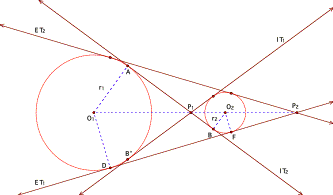
Figure 6.4
Consider
tangent  and radii
  and
and  . As triangles AO1P1 and BO2P1 are similar, we have
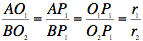
Now
consider the tangent  and radii
  and
and  . As triangles
  and
and  are similar, we
have
are similar, we
have
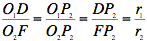 (2)
(2)
From
(1) and (2), we establish a relationship between  :
:
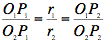 (3)
(3)
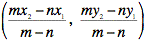
Recall, the Ratio theorem states that if a point L divides the line segment joining  and
and  internally in
the ratio
internally in
the ratio  , then its coordinates are given by
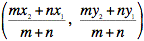
On
the other hand, if the point L
divides the segment AB externally, the coordinates of L are given by

From equation
(3),  and
and  .
.
The coordinates of the point  can be obtained
by applying the Ratio Theorem as
can be obtained
by applying the Ratio Theorem as  divides the
segment
divides the
segment  in the ratio
  , i.e., coordinates of
  are
are
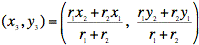 .
.
Using
similar arguments, the coordinates of  are
are
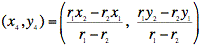 .
.
Let the equations of the internal tangents  and
and  be
be  and
and  , where
  and
and  are their
respective gradients. We determine the values of
are their
respective gradients. We determine the values of  and
and  by using the
fact that the perpendicular distance from
by using the
fact that the perpendicular distance from  to
to  is
is  . Recall that the formula for finding the distance from a
point, say
. Recall that the formula for finding the distance from a
point, say  to the line
  , given by
 .
.
The
distance of  to the line
  with equation
  is
is
 .
.
Since the centre of the circle  and its radius
  are known, we
can solve the above equation for
are known, we
can solve the above equation for  .
.
Similarly, let the equations of the external tangents  and
and  be
be  and
and  , where
  and
and  are their
respective gradients. We apply the formula for finding the distance from the
point
are their
respective gradients. We apply the formula for finding the distance from the
point  to the line
  given by
  . This is given by
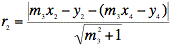 .
.
Note:
If the distance between  and
and  is larger than
the sum of the respective radii (
is larger than
the sum of the respective radii ( ), then the two circles do not intersect.
Illustrative
example
Consider
the two non-intersecting circles 
 and
and 
 with centers
  and
and  and radii
  and
and  , respectively.
Here,
 and
and  .
.
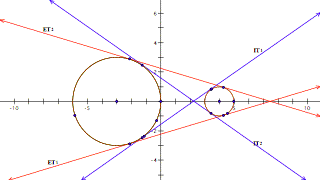
Figure 6.5
We
find the equation of the internal tangents  and
and  .
.
Coordinates of  are
are
 .
.
We
determine the value of  .
.
 .
.
This
gives  .
.
Equation
of  and
and  are
are 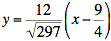 and
and 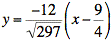 .
.
Similarly, we can determine the equation of the external
tangents  and
and  .
.
Coordinates  are
are
 .
.
 .
.
Solving
the above equation gives  .
.
Equation
of  and
and  are
are 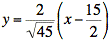 and
and 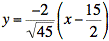 .
.
References
Durell, C.V. (1965). A new geometry for schools: Stage A
and Stage B. London: G.Bell and Sons
Srinivasan, V.K. (2002). Two circles and their tangents. International
Journal of Mathematics, Education, Science and Technology, 33,
627-636
25 October 2006
Ajay Ramful