
Assignment 7
Tangent Circles
Consider circles C1 and C2 with
centers O1 and O2 and radii r1 and r2.
Without loss of generality we assume that r1 > r2. We
shall discuss the construction and properties of the tangent circles in each of
the following cases:
(i) C2 is inside C1
(ii) C1 and C2 are disjoint
(iii) C1 and C2 intersect
Figure 7.1 shows circles C1 and C2
and the aim is to construct a circle which is tangent to these two circles. We
call this tangent circle C3 and denotes its center by O3
and radius r3.
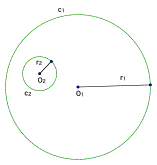
Figure 7.1
STEP 1:
Choose an arbitrary point A on the circumference of C1. Join O1
to A (Figure 7.2). The center of the tangent circle should be somewhere along O1A
as O1A (being a radius of C1) makes a right angle with
the tangent drawn at A. The radius r3 of the tangent circle C3
should also make a right angle at A.
Let B (unknown) be the point on the circle C2
which is tangential to the circle C3. In other words, the circle C3
is tangential to C1 and C2 at A and B respectively. In
addition, O3A = O3B = r3 and the triangle
O3AB is isosceles. To obtain O3 we can bisect AB and find
the intersection of this bisector with AO1. However, the point B is
unknown. Thus, instead of working with the point B, we work with the center O2.
The length of O2O3 is r2 + r3 . If we extend O3A
by r2 to the point C as shown in Figure 7.2, then O2O3
= O3C. This can be achieved by the construction in step 2.
STEP 2:
Draw a circle of radius r2 at A and extend O1A to C.
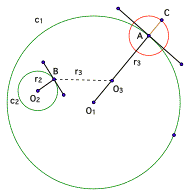
Figure 7.2
STEP 3:
Find the bisector of O2C. The intersection of the bisector and AO1
gives O3.
STEP 4:
With O3 as center and radius O3A (r3) draw the
tangent circle.
As the arbitrary point A moves around the
circumference of circle C1, it generates different tangent circles
(Figure 7.3).
Click
HERE for a scrip tool for constructing tangent
circles.
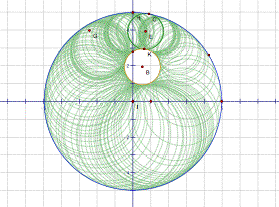
Figure 7.3
These tangent circles exhibit a number of interesting
properties. As a particular example, consider the circle C1 with
equation x2 + y2 = 25 and circle C2 with
equation
(x- 0.52)2 + (y – 1.93)2 = 1 in Figure 7.4. We
superimpose a grid of polar coordinates to keep track of the motion of the
tangent circles.
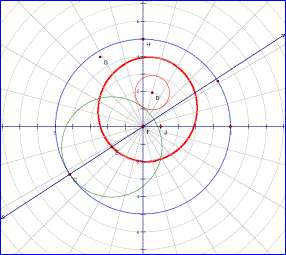
Figure 7.4
The length of the radii of the tangent
circles are noted at intervals of 150 in Table 7.1. The angle is
measured from the center of circle C2 anticlockwise.
|
Angle (in degrees) |
Radius |
Angle (in degrees) |
Radius |
|
0 |
1.0 |
195 |
3.0 |
|
15 |
1.1 |
210 |
3.0 |
|
30 |
1.3 |
225 |
2.9 |
|
45 |
1.5 |
240 |
2.7 |
|
60 |
1.8 |
255 |
2.6 |
|
75 |
2.1 |
270 |
2.4 |
|
90 |
2.4 |
285 |
2.1 |
|
105 |
2.6 |
300 |
1.8 |
|
120 |
2.7 |
315 |
1.5 |
|
135 |
2.9 |
330 |
1.3 |
|
150 |
3.0 |
345 |
1.1 |
|
165 |
3.0 |
360 |
1.0 |
|
180 |
3.0 |
|
|
Table 7.1
A plot of the values in Table 7.1 is shown in Figure
7.5.
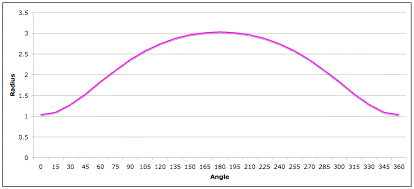
Observe the symmetry in the curve. This suggests that
the centers of the tangent circles follow certain pattern. A trace of the loci of the centers of
the tangent circles is shown in Figure 7.4. The locus is an ellipse with foci
at the centers of the large and small circles.
The equation of the trace is derived below. Here the
axis of the ellipse is neither horizontal nor vertical and the center is not
the origin. In other words, the centre of the ellipse has been translated and
the axes have been rotated as shown in Figure 7.6.
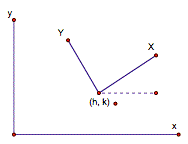
This
transformation can be represented by
 .
.
In
Figure 7.4, the ellipse has foci at and
and 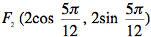 , and centre
 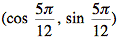 . Consider an equivalent ellipse along the x- and
y- axis as shown in Figure 7.7.
. Consider an equivalent ellipse along the x- and
y- axis as shown in Figure 7.7.
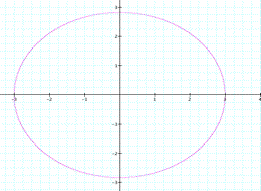
Figure 7.7
We
use the usual notations a, b, c and e to define the ellipse. Here, a = 3 and ae =1 or  ;
;  Therefore, the
equation of the ellipse, centred at the origin with eccentricity 1/3 is
Therefore, the
equation of the ellipse, centred at the origin with eccentricity 1/3 is  .
.
Now,
we determine the equation of the trace in Figure 7.4 by shifting the centre of
the present ellipse to  and rotating it
by
and rotating it
by  . This gives

A number of
other investigations can be performed by shifting the center of the circle C2
at different locations and
comparing the shape of the graph shown in Figure 7.5 in terms of amplitude.
Further, the radii of C1 and C2 can also be varied or
maintained in fixed ratio r1/r2 and compared. In
addition, the equation of the ellipse formed by the trace can be parametrized
and a distance function between the ellipse and the outer circle C1
can be derived.
We can also make a tangent circle which contains the
smaller circle C2 as shown in Figure 7.8.
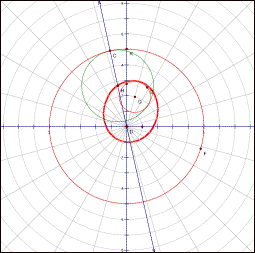
Figure
7.8
The change in the length of the radii of the tangent
circle in this case is shown in Table 7.2. As in Table 7.1, the angle is
measured from the center of circle  anticlockwise.
|
Angle (in degrees) |
Radius |
Angle (in degrees) |
Radius |
|
0 |
2.0 |
195 |
4.0 |
|
15 |
2.1 |
210 |
3.9 |
|
30 |
2.4 |
225 |
3.9 |
|
45 |
2.7 |
240 |
3.8 |
|
60 |
3.0 |
255 |
3.7 |
|
75 |
3.3 |
270 |
3.5 |
|
90 |
3.5 |
285 |
3.3 |
|
105 |
3.7 |
300 |
3.0 |
|
120 |
3.8 |
315 |
2.7 |
|
135 |
3.9 |
330 |
2.4 |
|
150 |
4.0 |
345 |
2.1 |
|
165 |
4.0 |
360 |
2.0 |
|
180 |
4.0 |
|
|
Table 7.2
Figure 7.9 compares the radii of the tangent circles
in Tables 7.1 and 7.2. We observe that the radii are much larger for the outer
tangent circle and the difference between the radii range from 1.0 to 1.2.
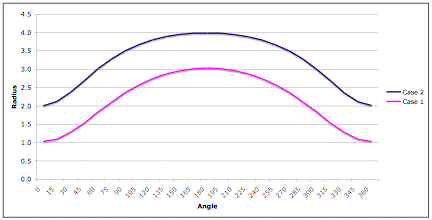
Figure
7.9
The properties of tangent circle when C1
and C2 intersect or are disjoint will be discussed later.
22 October 2006
Ajay Ramful