
Assignment 8
Triangle of minimal perimeter
Fagnano’s
problem
Given
a triangle, find the triangle of minimal perimeter that can be inscribed in it.
Consider
the acute-angled triangle ABC in Figure 8.1.
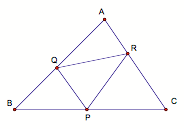
Figure 8.1
The
problem is to find the triangle PQR such that it has minimal perimeter. The
solution to this problem lies on the following premise:
Consider
triangle LMN and an arbitrary point P as shown in Figure 8.2.
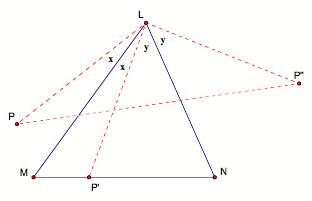
Figure 8.2
Reflect
P on LM to obtain  . Thus
  and
and  .
.
Reflect
 on LN to obtain
  . Thus
  and
and  .
.
Thus, we conclude that  and
and  .
.
We use the above result to find the triangle of
minimal perimeter.
In Figure 8.3, reflect PQ on side AB to obtain  . Similarly, reflect PR on side AC to obtain
  . The perimeter of triangle PQR is now
  .
.
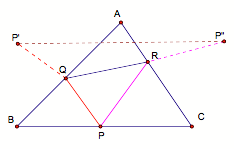
Figure 8.3
For
the perimeter to be minimized,  should be
collinear. Now,
should be
collinear. Now,  and
and  . Triangle
  is isosceles.
Because
is isosceles.
Because  is independent
of the choice of P, the base
is independent
of the choice of P, the base  will have
minimum measure when the equal sides
will have
minimum measure when the equal sides  and
and  have minimal
length. However, these two sides are equal in length to AP and AP
has minimum length when it is perpendicular to BC, i.e., when AP is the altitude of triangle ABC at A. Similarly, Q and R
must be the feet of the other altitudes of triangle ABC.
have minimal
length. However, these two sides are equal in length to AP and AP
has minimum length when it is perpendicular to BC, i.e., when AP is the altitude of triangle ABC at A. Similarly, Q and R
must be the feet of the other altitudes of triangle ABC.
Thus,
the triangle with the minimum perimeter is the Orthic triangle (Figure 8.4).
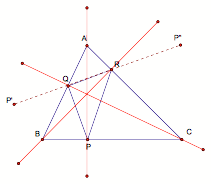
Figure 8.4
The Orthic
triangle is the name given to the triangle joining the feet of the altitudes at
P, Q and R. Some of its properties are:
(i)
Its respective angles
can be computed by subtracting 2 times the opposite angles in the original
triangle. For example in Figure 8.4, 
 , and
, and  .
.
(ii)
The altitudes of the
original triangle ABC are the bisectors of the Orthic triangle PQR. Thus, the
incenter of the Orthic triangle is the orthocenter of the original triangle.
(iii)
The perimeter of the
Orthic triangle is  . Observe that this formula allows the
computation of the perimeter of the Orthic triangle using the dimensions of the
original triangle.
. Observe that this formula allows the
computation of the perimeter of the Orthic triangle using the dimensions of the
original triangle.
In Figure 8.4, AB = 5.82 cm, BC = 7.83 cm, CA = 7.48
cm, PQ = 3.20 cm, QR = 2.60 cm, PR = 4.13 cm,  ,
,  and
and  .
.
Perimeter of Orthic triangle is 

This is equal to PQ + QR + RP = 3.20 + 2.60 + 4.13 =
9.93 cm.
(iv)
Area of triangle ABC =  , where L is the perimeter of the Orthic triangle and R is the radius of the circumscribed circle of ABC.
In
Figure 8.4, area of triangle ABC = 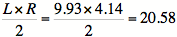
 .
.
Note
that because the Orthic triangle depends on the altitudes of the original
triangle ABC, its vertices may be
outside the triangle ABC. This occurs when ABC is an obtuse-angled triangle.
For right-angled triangles, the Orthic triangle degenerates to a line.
Click
HERE to experiment with different type of triangles
ABC and their corresponding Orthic
triangles.
12 November 2006
A. Ramful