
Assignment 9
Pedal triangles
Let ABC be a triangle and let P be a point in the same plane. The pedal triangle of P is the triangle determined by the feet of the
perpendiculars from P to the sides
of triangle ABC. The point P is
called the pedal point. Figure 9.1a and 9.1b shows the pedal triangle for a
point interior and exterior to triangle ABC, respectively.
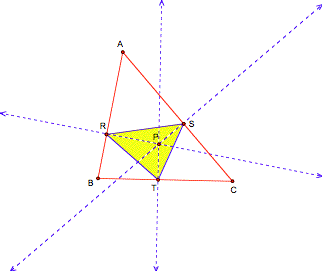
Figure 9.1a
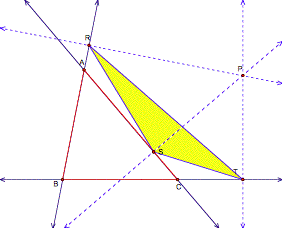
Figure 9.1b
The pedal triangle exhibits some interesting
properties depending of the location of the pedal point. Table 9.1 shows the
nature of the pedal triangle when the pedal point P lies on the circumference, incenter and orthocenter
of acute-angled triangles.
|
Position of pedal point, P |
Nature of pedal triangle |
|
Circumcentre |
Medial
triangle |
|
Incentre |
Pedal
triangle lies on the inscribed circle |
|
Orthocentre |
Orthic
triangle |
Table 9.1
If the pedal point P lies on one of the sides of the triangle ABC, it
becomes a vertex of the pedal triangle. When P lies on the circumcircle of triangle ABC, the three
vertices of the pedal triangle are collinear (i.e., it is a degenerate
triangle). The line segment is called a Simpson line. As the pedal point P moves towards the vertex A in Figures 9.2a, 9.2b, and 9.2c, the three vertices of
the pedal triangle tend to the Simpson line. Similar observations are made when P moves towards vertices B and C.
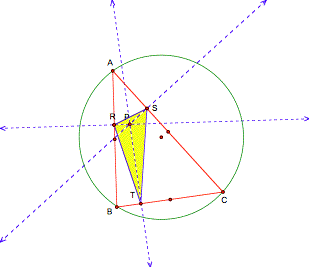
Figure 9.2a
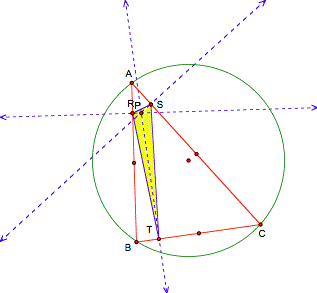
Figure 9.2b
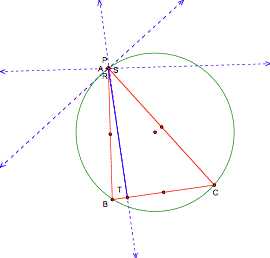
Figure 9.2c
The midpoints of the pedal triangle also display some
insightful features. Figure 9.3 shows the loci of these midpoints as the pedal
point P moves round a circle
concentric to the circumcircle of triangle ABC but having a larger radius. The midpoints of the
pedal triangle RST are denoted by X, Y, and Z. We
observe that three ellipses are generated.
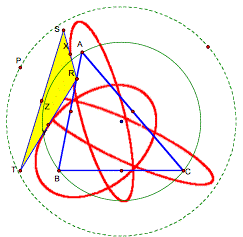
Figure 9.3
Click
HERE for animation
We can also observe the pattern generated by the
Simpson line as the pedal point moves around the circumcircle. This gives rise
to an envelope of Simpson lines as shown in Figure 9.4.
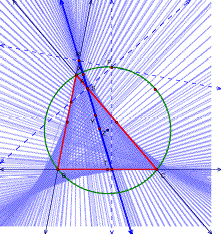
Figure 9.4
Click
HERE for animation
Similarly, we can investigate what happens when the
pedal point is on the incircle. Once again we have three ellipses. When the
triangle is right angle, we have two ellipses and a circle (Figure 9.5).
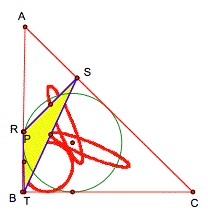
Figure 9.5
Click
HERE for animation
Another possible path for investigating the properties
of pedal triangles is when the pedal point is on the excircle. Just like in the
above cases, three ellipses are generated as illustrated in Figure 9.6.
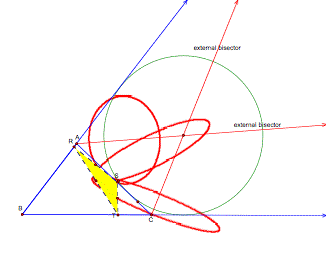
Figure 9.6
Click HERE
for animation
Reference
Honsberger, R. (1995). Episodes in nineteenth and twentieth century Euclidean geometry. The Mathematical Association of America
26 November 2006
Ajay Ramful