Optimizing
Triangles
Kim Seay
EMAT 6680
For this exploration you
must begin with a triangle that is inside of a circle. One vertex
of the triangle must be at the center of the circle and the other
two vertices should be on the circle. The question is, what central
angle of the triangle will result in a triangle with the maximum
area?
Start off by creating such
a triangle in GSP. Click here to
open a sketch that will create a triangle meeting the above criteria
when first a point on the circle and then the center of a circle
is selected. After you have this construction, measure the central
angle and the area of the triangle.
By clicking and dragging
a vertex of the triangle around the circle, you can watch the
relationship between the area of the triangle and the central
angle as they change. It should be easy to see that the area of
the triangle increases as the central angle approaches 90 degrees
and then begins to decrease after that point. Click
here to see an animation of this in GSP.
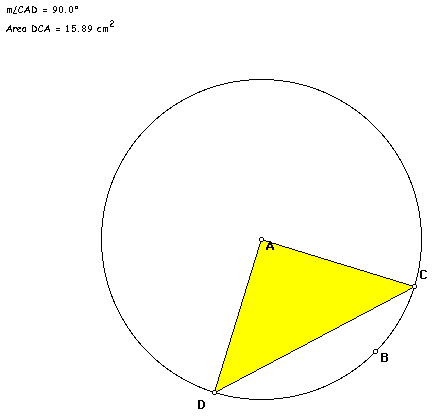
Thus, the triangle will
reach an optimum area at a central angle = 90 degrees as seen
below.
What about minimal
area?
This exploration also leads
to the question "What central angle of that same triangle
will produce minimal area?" You can answer this question
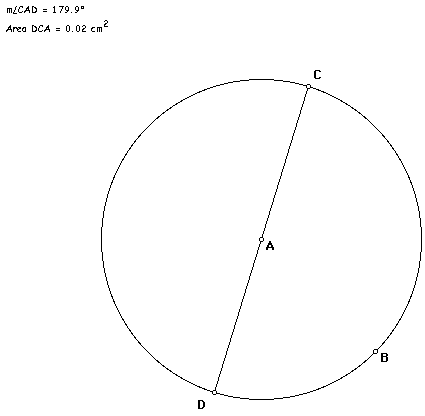
in the same manner. It is also important to recall that when the
central angle equals 180 degrees the area of the triangle will
equal zero, because it becomes a straight line. The idea, is to
get as close to 180 degrees as possible. You can see a picture
of this below. The triangle is so small it can not be seen, but
the area shows that the picture is actually of a triangle with
an area equal to 0.02cm^2.
Conclusion:
I think this is a good exploration
for students, because it utilizes many tools in Geometers Sketchpad.
It would be good to use with my sixth grade students who are beginners
with the program. The exploration allows you to use the script
and animation tools in a very elementary way. I would assist the
students with the steps of creating the construction, making a
sketch, and animating the point D, but then I would allow them
to draw conclusions about the relationship between the area and
the angle on their own.
Return