
Quadrilateral
Any four-sided figure is called a quadrilateral. Think about the shape of a computer screen, a basketball court, a baseball diamond, a kite or a dollar bill. Notice that the below shapes do not all look a like, but they do all have one thing in common.

Parallelograms
ABCD is a quadrilateral. 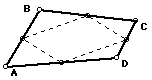 When
we find the midpoints of each side and connect them to each other, another
qudrilateral is formed. Do you know what type it is?
When
we find the midpoints of each side and connect them to each other, another
qudrilateral is formed. Do you know what type it is?
Many quadrilaterals are parallelograms. Their opposite sides are
parallel to each other as well as being the same length; that is, they are
congruent. 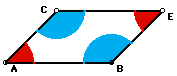 Opposite angles in the parallelogram
are equal. On the other hand, the consecutive angles of a parallelogram
are not equal (unless it is a rectangle) but they do have a special relationship.
Can you tell what it is?
Opposite angles in the parallelogram
are equal. On the other hand, the consecutive angles of a parallelogram
are not equal (unless it is a rectangle) but they do have a special relationship.
Can you tell what it is?
Investigate: Now let's look at the diagonals of a parallelogram. Are they the same length? What can you tell about the pieces of the diagonals that are cut by the other diagonal? Can you see that they bisect each other?
Rectangles
A rectangle is a special type of parallelogram. It
has opposite 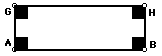 sides parallel, opposite sides
congruent, and four right angles. It is an
equiangular parallelogram.
sides parallel, opposite sides
congruent, and four right angles. It is an
equiangular parallelogram.
Investigate: Now let's look at the diagonals of the rectangle. Do you think there is anything special about them? How are they different from the diagonals in a general parallelogram?
Rhombi
Another type of parallelogram is a rhombus. It has four congruent sides.
Investigate: 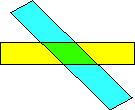 What type of
rhombus is created when it has four right angles? Create: One way
to form a rhombus is by first drawing a set of parallel lines. This can
easily be done with a ruler. Just draw a line on each side of the ruler.
Then turn the ruler and draw a second set of parallel lines across the first
set. Notice that the length of each side of the rhombus in the same Now
draw the diagonals of the rhombus. Investigate: What do you notice?
What kind of angles are they? How would you prove that?
What type of
rhombus is created when it has four right angles? Create: One way
to form a rhombus is by first drawing a set of parallel lines. This can
easily be done with a ruler. Just draw a line on each side of the ruler.
Then turn the ruler and draw a second set of parallel lines across the first
set. Notice that the length of each side of the rhombus in the same Now
draw the diagonals of the rhombus. Investigate: What do you notice?
What kind of angles are they? How would you prove that?
Square
A special type of rectangle is called a square.  It has the four right angles of a rectangle, both pairs of opposite
sides are parallel, but all the sides are the same length.
It has the four right angles of a rectangle, both pairs of opposite
sides are parallel, but all the sides are the same length.
Investigate: Let's draw one diagonal on the square. What type of figures do you see now? What happens when the second diagonal is added? Can you see that the diagonals here are perpendicular bisectors of each other? Notice that a square is an equiangular rhombus, as well as being an equliateral rectangle.
Trapezoids
A trapezoid is a quadrilateral at least 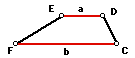 one pair
of parallel sides. These parallel sides are called bases. The angles that share a base as
a common side are called a pair of base
angles. (P) There is a relationship between the
consecutive angles between the bases of the trapezoid. Can you see what
it is?
one pair
of parallel sides. These parallel sides are called bases. The angles that share a base as
a common side are called a pair of base
angles. (P) There is a relationship between the
consecutive angles between the bases of the trapezoid. Can you see what
it is?
If the sides 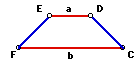 of a trapezoid
that are not parallel are exactly the same length, the trapezoid is said
to be isosceles. Where have we seen that term before? Compare the base angles
of an isoceles trapezoid. Now let's look at the diagonals of an isoceles
trapezoid. Compare their lengths.
of a trapezoid
that are not parallel are exactly the same length, the trapezoid is said
to be isosceles. Where have we seen that term before? Compare the base angles
of an isoceles trapezoid. Now let's look at the diagonals of an isoceles
trapezoid. Compare their lengths.
Trapezoidal shapes are often used in building arches, where each block or stone supports, and is supported by, the pieces above and below it. Another use is in binoculars in which the magnifying lenses invert the image. Trapezoidal prisms are used to turn the inverted images right side up again.
Puzzles & Experiments
Puzzles & Experiments in Quadrilaterals