
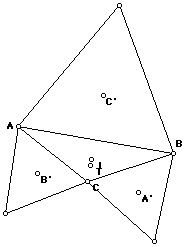
Given any triangle ABC, construct equilateral triangles externally on each side; locate the centroid of each triangle and join it with the oposite angles ABC. Show that the lines are concurrent and explore the relationship between the point of concurrence and the orthocenter, centroid, incenter, and circumcenter of the triangle ABC.


But the trianges are internal to each side. (Nevertheless observe that
if the lines are extended they will intersect at the same point:  )
)
I restricted my search to the case in which the triangles are always external.
So I labeled T the point of concurrence:
Let's see if there is any relationship between T and other concurrent points
of the triangle ABC. T is not hte centroid, as the following two examples
show:


It is not the orthocenter either:


It is not the incenter either!
Nor the circumcenter: (I labelled the circumcenter K, because I had C
as a vertex of our original triangle)

Well, then what are the characteristics of this point T?
Lets analyze if there is any relationship between H, K, and T (the orthocenter
and the circumcenter):

They do not seem to be colinear...

No; they are not colinear. What about the pair K and G with respect to
T (the circumcenter and the centroid)?

They are not colinear either. Let's check the pair H and G with respect
to T (the orthocenter and the centroid):

No! These points are not colinear either! Well, lets check the incenter
I and the centroid G, with respect to T:

These three points are not colinear either. We still need to check the triplets
I, H and T, and I, K and T. Let's check the incenter, the orthocenter and
our T:

They are not colinear, either; What about our last pair, the incenter
I, the circumcenter K, and our T?

Neither. So although T is a concurrency point, it is not colinear to
any of the 'key' points of the original triangle ABC. Probably we would
like to set some conditions on ABC, and see if there us some relationship.
What if the triangle ABC is straight?

Again the answer is NO. Wha tif the triangle is isoceles?

Well, here is something. So probably we can state that if the original
triangle ABC then all the points are colinear; observe some other examples:


Well, it seems that here we have a nice thing to proof. Another special
case is when ABC is equilateral. In this case, all the points are concurrent!
(Proofs of these facts are given in the section "Proofs")

Given any triangle ABC, the lines AA', BB', and CC' that join the centroids A', B', and C' of the external equilateral triangles built on each side of the triangle ABC, with the opposite angles A, B, and C respectively, are concurrent, at some point T.
Definition
A Fermat Point of a triangle ABC is that point whose distance from ABC to it is the smallest possible.
Lemma
The Fermat Point subtends angles of 120o with each side AB, BC, and CA.
Proof.
Take any triangle ABC and draw the lines from P to the vertices:

Next rotate the two segments BP and PA 60o counterclockwise over B, and join the reflexed point P' to P:

By construction the triangle BPP' is equilateral, and the lenght of A'P' is the same lenght of AP. It means that AP=A'P' and that BP=PP'. Therefore
So in order to have a minimal distance between a minimal distance from P to each vertex, we need to have a straight line joining A' and C; i.e. that we need to have:
But we know that angle P'PB is 60o, that means that angle BPC must be 120o.
If we do the same construction beginning with other side, then we obtain that AP + BP + PC minimal when P subtends an angle of 120o with each of the sides BC, CA and AB.

If we construct the circumcircle of the triangle ABC, we get:

Then observe that P must lie in the 2nd intersection of A'C and the circumcenter of the equilateral triangle A'BC!:

Since our triangle is isosceles, then PP' lies on the line that joins K and C:

It means that P lies on the Euler line of A'AB. Repeating the construction
given in the lemma using side AC and BC we obtain two equilateral triangles
external to these sides and the lines conecting the circumcenters passing
through the point P. Since in an equilateral triangle the circumcenter and
the centroid coincide, we got that our proposition. Since an equilaterla
triangle can be seen as a tree-ways isosceles triangle, then we get that
for this case all the points coincide.