Bicycle Acceleration
Purpose: The purpose of this experiment is to investigate how displacement,
acceleration, and time are related using a gentle hill
and a bicyclist.
Materials: gentle hill, chalk, meter stick, bicycle, timer
Procedure:
1. Select a paved hill which has a constant gentle slope. Use chalk to
mark a finish line across the bottom of the hill.
2. Draw three more lines across the hill, one 5m up from the finish, one
10m up from the finish, and one 20m up from the finish. Measure those distances
carefullly using a meter stick.
3. Each rider will start from rest at the 5m mark. Without pushing, the
bicyclist will coast to the finish line. Record how long it takes to travel
the 5m in the data
table for three trials. Average.
4. Record the time for the rider to travel 10m and then 20m, each time
starting from rest.


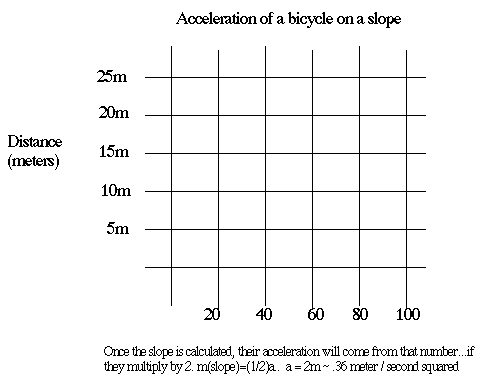
Find the slope, m
m=(1/2) a
Solve for a (acceleration). That is acceleration down the hill found graphically.
LAB #3
Bicycle Acceleration
The students collected time and distance data outside on a bicycle.
The lab report required them to calculate their acceleration down a slope
on the bicycle. Since Distance = 1/2 (acceleration) ( time)^2 their acceleration
could be calculated by graphing distance on the y-axis and time squared
on the x-axis.