
 and
and  (a
is real number)
(a
is real number)Substance y = ax for
Then


When x=0 the equations is conclusion with y=0. Therefore, if a is any number, there is the intersection of origin.
When x not = 0 then 
If 

therefore a=1
Then ,substance a=1 for
Then 0=3
It's not true. Therefore, as a=1, there is only intersection of origin.
If a not =1


And

The coordinates of the intersections without the origin are below.

The only sings differ from the two coordinates, so these two points are the central symmetry with the central point of origin.
For these coordination numbers are the real number:
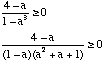
By the way
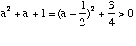
Therefore
For
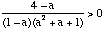
 and
and  so
so 
or
 and
and  so
so 
Summary
As  , there is the only intersection
of the origin.
, there is the only intersection
of the origin.
As or ,there
are three intersections.
 The intersections are
The two intersections of the first are the central symmetry with the center point of (0,0).