 and
and  and
and In the previous pages, we discussed the effects a had on the graph of
but, how much impact does it have on the graph
of ?
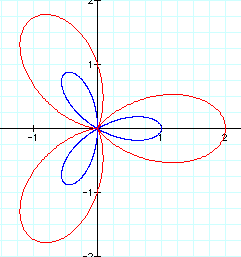
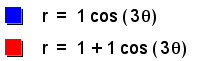
We can see from this layered graph that a value of a affects the size of the petals. The petals are much longer and wider when a does not equal zero.
Will a value of a that is less than 1 have the same effect? Meaning, will the petals be longer and wider, or will the petals, since the value is less than one, shrink?
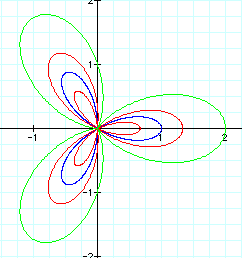
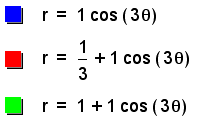
We can see that a value of (1/3) for a does not have the same effect, nor does it cause the petals to shrink. When a = 1/3, there are two sets of petals, one is larger and appears more rounded, but not as large and round as a value of a =1 created. The other set of petals is smaller and appears less rounded.
A similar graph is created by keeping a =1, but changing the value of b.
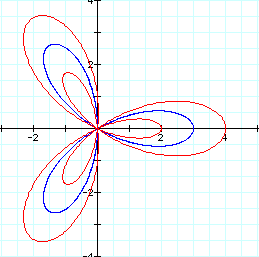
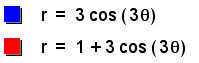
When a=o, but b=3, the petals
appear longer, but when a=1, and b=3, the result
is two sets of petals. This is similar to the graph of 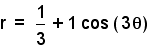
Are those two graphs the same?
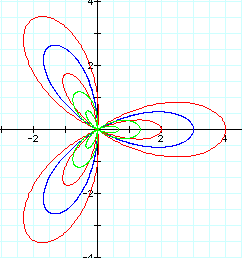
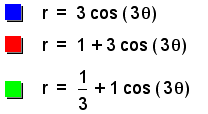
No, the graph of  has
much larger petals than the graph of
has
much larger petals than the graph of 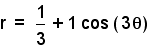
An extension to this problem would be to consider the areas enclosed by those two equations.
Is the area enclosed by the graph of
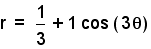
(1/3) of the area enclosed by the graph of
 ?
?Click here to return to the Polar Equations main page.
Click here to return to Julie's main page.