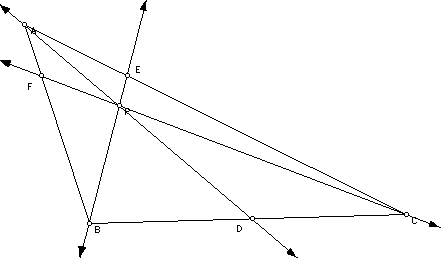
Consider any triangle ABC. Select a point P inside the triangle. Draw lines AP, BP, and CP, extending to their intersections with the opposite sides at points D, E, and F respectively.
We are to explore (AF) (BD)(EC). After long thought about this one I decided to multiply the differnet line segments and divide it by (FB)(DC)(EA) for different triangles and differnet locations of point P. I first looked at the values that GSP gives for AF, BD, EC, FB, DC, EA, and finally (AF)(BD)(EC)/(FB)(DC)(EA).
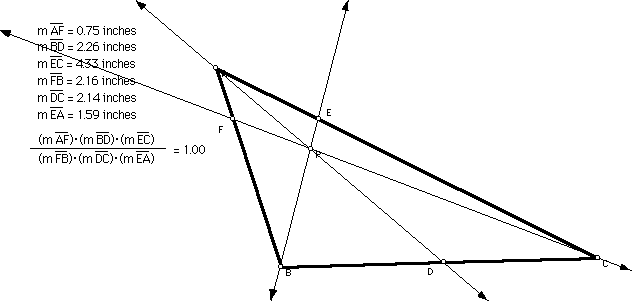
The ratio is one. Let's move P around to see if this ratio stays one all the time. First let's move P to another place inside the triangle.
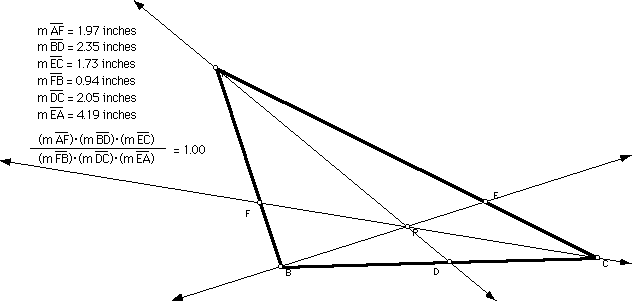
The ratio is still one. But, what happens if point P is moved to the outside of the triangle? Will the ratio still be one?
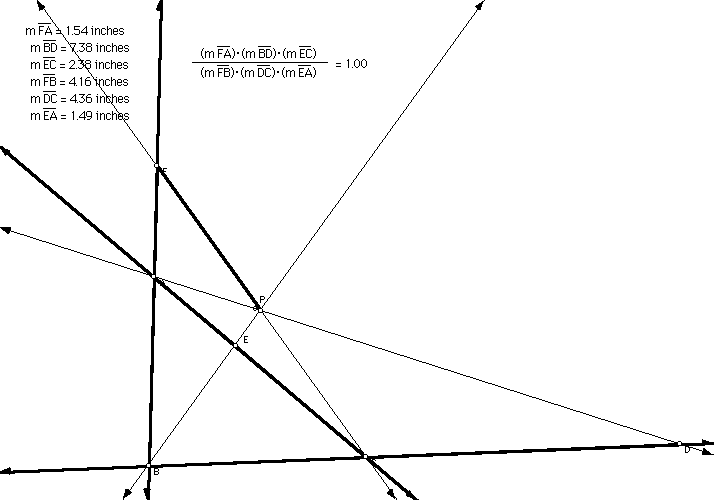
The ratio is still one. I can' t believe it. Now it is time to make a conjecture, right? Well, I feel that the ratio of the segments in this way will always be ONE. After further exploration into the matter I believe this conjecture to be true. But what is the best way to find out whether it is true or not...PROVE IT.
PROOF: I want to prove that (AF)(BD)(CE)/(BE)(CD)(AE)=1
Looking back at the first triangle with point P on the inside, I want to construct a line parallel to BF going through point A and going through C. I also want to see where these new lines intersect our previous lines through P.
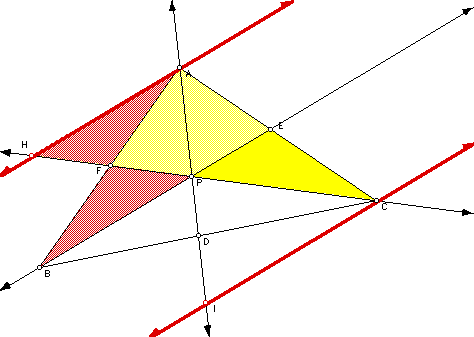
We get the following similar triangles:
BecauseTriangle AHF is similar to Triangle BPF, I deduce that AH/ BP = AF/ BF. Because Triangle BPD is similar to Triangle ICD. I deduce that BD/CD = BP/IC. SO then the following happens:
Just like magic!
Because Triangle AHC is similar to Triangle PEC, I deduce again that PE/AH = CE/AC. And becuase Triangle ICA is similar to PEA, I conclude that IC/PE = AC/ AE.
Then the follow happens:
To conclude, I get this out of all of the previous mathematics:
Which is what I wanted.
Next, I want to show that when P is inside triangle ABC, the ratio of the areas of triangle ABC and triangle DEF is always greater than or equal to 4.
Below is an animation where we can see P moving. What I noticed is that the ratio is equal to 4 when P is the centroid of triangle ABC, then D, E, and F are the midpoints of the sides and the triangle DEF is 1/2 (1/2bh) = 1/4. Where the ratio comes from.