
DAY 8. Flip Image in the Coordinate Geometry
Assumptions :
Students have learned the concept of the polygon.
Students have learned the construction of the polygon with the
ruler and the compass.
Students have learned the reflection of the image.
Materials :
Ruler, Compass, Graph paper and Tracing paper.
Goals :
Students will explore the polygon in the coordinate
plane.
Students will explore the flip image of the polygon as a reflection.
Students will explore reflection with the distance formula and
the midpoint formula in the coordinate plane.
Act I
1) With the small group of 3-4 students, they draw a square with the length of 3 unit and the point B=(-4, 5) in the graph paper. It can be different the position of the square. The below figure is one example. Students put the coordinate of each point of the square. In this case, it will be A=(-4, 2), B=(-4, 5), C=(-1, 5) and D=(-1, 2).
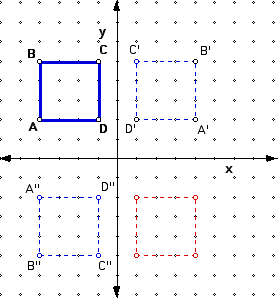
2) With the tracing paper, trace the square and the y line. After they have done this, draw the flip image of the figure in the y line. The result is above. A'B'C'D' is the flip image of the square ABCD. Students put the coordinate of each vertex of the square. In above case, coordinates are A'=(4, 2), B'=(4, 5), C'=(1, 5) and D'=(1, 2).
3) With the tracing paper, trace the square and the x line. After they have done this, draw the flip image of the figure in the x line. The result is above. A"B"C"D" is the flip image of the square ABCD. Students put the coordinate of each vertex of the square. In above case, coordinates are A"=(-4, -2), B"=(-4, -5), C"=(-1, -5) and D"=(-1, -2).
4) There is a extra figure in the fourth quadrant as the red square. Let this figure be the student option to choose. If students try this figure, let them put the coordinates of the vertices of the red square. It will A'''=(4, -2), B'''=(4, -5), C'''=(1, -5), and D'''=(1, -2).
5) With the coordinates of four square, students will have the table, and generalize the pattern of the coordinates of the flip image.
|
|
|
|
|
|
|
|
|
|
|
|
|
|
|
|
|
|
|
|
|
|
|
|
|
|
|
|
|
|
Act II
Student will construct the equlateral triangle with the length of 4 unit and the starting point A=(5, 6) in the graph paper. It is important to find the third point so that it can be a equilateral. Student will repeat the above process 1) to 4), and make the table of the coordinates of three or four (if possible) equilateral triangle. Check if the generalization of above 5) can be applied in this case.
It can be a homework of the group!!
Day 9. Flip Image in the GSP
Act I
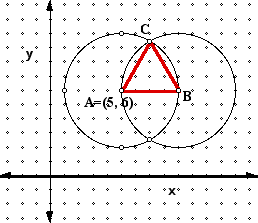
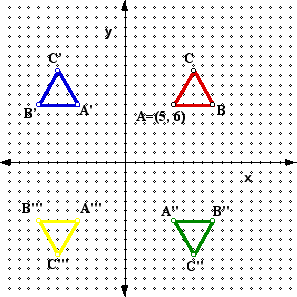
In Day9, we will explore the flip image in the GSP. At the begining, the Act II of the previous day will be dealt in the GSP file. Here is the GSP file. The above figure is the one example. There are so many possible equilateral triangle. Check this file for the possible figure.
|
|
|
|
|
|
|
|
|
|
|
|
|
|
|
|
|
|
|
|
|
|
|
|
|
Act II: Group Project" Reflect the Regular Polygon in the Coordinate Plane."
Another important part of this course is the group project: "Flip image in the coordinate plane." Teacher groups students as 8 groups of 3-4 students. Teacher exhibits the project, but in the project students can decide the level of difficulty in choosing the original image. The group can discuss the problem in the classroom and in the electronic communication. Then groups present their project in the Web site so that every students as well as teacher in this course can discuss each presentation.
|
1) Choose the regular polygon that the group like to construct in the coordinate plane. Click here to refer the construction of the regular ploygon. Match the coordinate of the vertices of the polygon. 2) Reflect the regular polygon in the x-axis and y-axis withou the reflection of the menu in GSP. (Option: Reflect the regular polygon in the y=x) Make the table of the coordinates of the vertices of the polygon. 3) Find the any formulas of the coordinate geometry that we've learned in the class in your flip images. 4) Prepare the group presentation in Day 10. |
Return to coordinate page
Return to homepage