
1. What is the sequence?
Suppose a real number  is supposed with every positive
integer n. Then the numbers
is supposed with every positive
integer n. Then the numbers

are said to form an infinite sequence or simply a sequence, and the numbers themselves are called the terms of the sequence. The following are all examples of sequence.
Example1. The sequence all of whose terms are ones:
Here  1, i.e.,
the number 1 is associated with every positive integer.
1, i.e.,
the number 1 is associated with every positive integer.
Example 2. The sequence of consecutive odd number:
Here 2n -
1.
Example 3. Consider the sequence specified by the formula
 .
.Write out the first seven terms of the sequence,
and find  ,
, and
and
 .
.
Here is the answer. The first seven terms of the sequence are
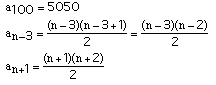 .
.The nth term of a sequence is called the general
term of the sequence. A sequence is often specified by giving
an explicit formula for its general term. Thus the sequence such
that  starts off like
The sequence with general terms is
often denoted by {}, i.e., by writing
the general term inside curly brackets.
2. Some examples of the sequence.
1)Find the formula for the general term of the sequence
Answer. One possibility
is 3n - 1.
Another is (3n
- 1) * (the number of digits un n). There are an infinite number
of other possibilities!
2) As a less obvious problem, find a formula for the general term of the sequence

Answer. One possibility is  .
.
3. Another example of the sequence.
One could hardly write a resonable formula for the general term of the sequence
Neverthless, the above sequence whose nth term
is the nthdigit in the decimal representation of the number Pi=
3.1415926...Hence there is actually a definite rule associating
a term of the above sequence with every
posotive integer n. For example, =3,
=3,
 =1,etc. Thus, despite the absence
of an explicit formula for the genenral term of this sequence,
it is possile, at least in principle, to find the number in any
given posotion, be it the first, seventh or 1007th position. in
particular, it can be shown that the above sequence is not periodic,
i.e., that no block of terms repeats itself over and over again
like the underlined digits in the decimal expansion of
=1,etc. Thus, despite the absence
of an explicit formula for the genenral term of this sequence,
it is possile, at least in principle, to find the number in any
given posotion, be it the first, seventh or 1007th position. in
particular, it can be shown that the above sequence is not periodic,
i.e., that no block of terms repeats itself over and over again
like the underlined digits in the decimal expansion of

4. Fibonacci Sequence.
Calculate the first 10 digits of the sequence
formed by the following rule: The first terms
equal 1(=1, =1),
while starting with the third term, every term is the sum of the
preceding two terms, i.e.,

 .
.There is an explicit formula for in
this case, but it is not too simple. The terms of the above sequence
are called the Fibonacci numbers, and the sequence itself
is called the Fibonacci sequence. Here
is the spreadsheet of the Fibonacci sequence.
Example. Find the first few terms of the sequence
whose nth term equals the sum of all the positive integers from 1 to n inclusive.
Answer. 1, 3, 6, 10, 15, 21,...
Solution. a1=1,
a2=1+2=3, a3=1+2+3=6, a4=a+2+3+4=10,... , =1+2+3+...+n,...
5. Mathematical Induction
If the first person i a line a woman and if there is another woman standing behind every woman (except the last), then every person in the line is a woman. The reasoning behind this somewhat facetious example occurs again and again in mathematics and is called the principle of mathematics induction. We now give a more serious formulation of this principle:
Given a sequence of assertions, if the first assertion is true and if every true assertion is followed by another true assertion, then every assertion in the sequence is true.
Example. Prove that for every positive integer n
 .
(1)
.
(1)This formula comprises a whole sequence of assertions:
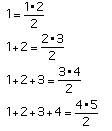 ....
....
The first assertion of obvious true. We now verify that every true assertion is followed by another true assertion. Suppose assertion k is true, i.e., suppose (1) is valid n=k so that
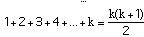 . (2)
. (2)Adding k+1 to both sides of(2), we obtain

But this is just assertion k+1, which comes right after assertion k. Thus we have shown that every true assertion is followed by another true assertion. Hence, according to the principle of mathematical induction, every assertion in the sequence is true, i.e., formula (1) holds for everypositive integer n.
Example The same problem can be solved without recourse to mathematical induction. Writing
1+2+3+
... +n,we have
1 +
2 + 3 + ... + (n-2) + (n-1) + n, (3)and by writing the first sum(3), we get the second sum(4)
n +
(n-1) + (n-2) + ... + 3 + 2 + 1, (4).Adding equations (3) and (4), we find that
[1+n]
+ [2+(n-1)] + [3+(n-2)] + ... + [(n-2)+3] + [(n-1)+2] + [n+1].Each term in brackets equals n+1, and there are exactly n such terms. In other words,
(n+1)
+(n+1) + ... + (n+1) +(n+1) = n(n+1),and hence
,which is just another way of writing (1).
6. Another form of the principle of mathematical induction
Another somewhat different form of the principle of mathematical induction goes as follows:
Given any assertion involving an arbitrary positive integer n, suppose that
a) The assertion is true for n=1;
b) Validity of the assertion for n=k implies its validity for n=k+1.
Then assertion is true for every positive
integer n.
7. One problem using the principle of mathematical induction.
Prove that  is
divisible by 5 for every positive integer n.
is
divisible by 5 for every positive integer n.
The proof involves two steps:
a) If n=1, equals
0 and hence is trivially divisible by 5.
b) Let n=k be an arbitary positive integer
k, and suppose  is divisible by
5. Then
is divisible by
5. Then  is also divisible
by 5. In fact, it follows from
is also divisible
by 5. In fact, it follows from

that
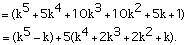
But each term of the terms on the right is
divisible by 5, the first by hypothesis, the second since it is
obviously a multiple of 5. Since the sum of two numbers divisible
by 5 is itself divisible by 5, it follows thatis
divisible by 5. Thus hypothesws a) and b) figuring in the second
formulation of the principle of mathematical induction are satisfied.
Therefore is divisible
by 5 for every positive integer n.
Return to homepage.