
Curves that are not graphs of functions can
often be specified by using a pair of equations x=x(t) and
y=y(t) to express the coordinates of a point (x,y) on the curve
as functions of an auxiliary variable t.
These are called parametric equations for the curve, and variable
t is called a parameter. Parametric
equations arise naturally if one imagines a plane curve C to be
traced by a moving point. If we use the
parameter t to denote time, then the parametric equations x=x(t)
and y=y(t) specify how the x- and
y-coordinates of the moving point vary with time.
Let's try the graph of x=cos(t) and y=sin(t) with t in (0,2Pi).
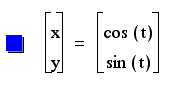
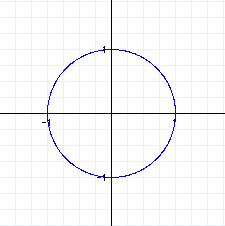
The graph of x=cos(t) and y=sin(t) with t in (0,2Pi) is centered atthe origin.
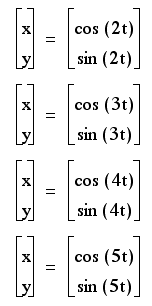
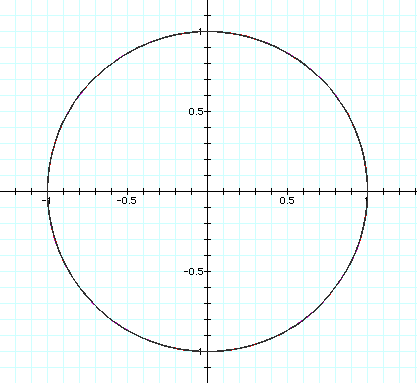
Secondly, Let's think about the graph of multiple of t. It is no matter how many it is multiplied to t. The following equations have the same graph like the below graph.
If so, Let's mutiply t to one function. The following is the graph when only sin has the multile. It result the "bow tie" with the same bow of multiple.
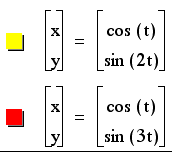
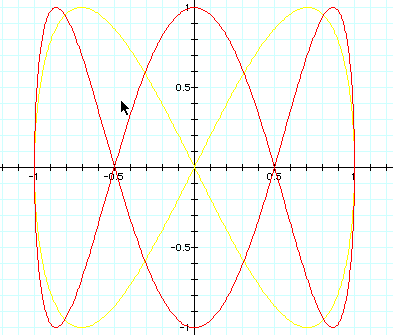
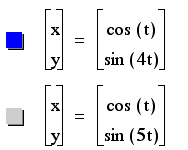
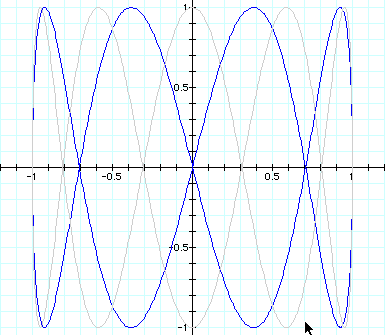
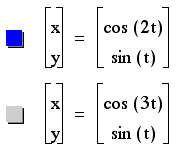
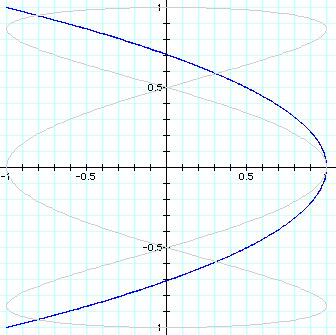
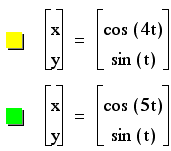
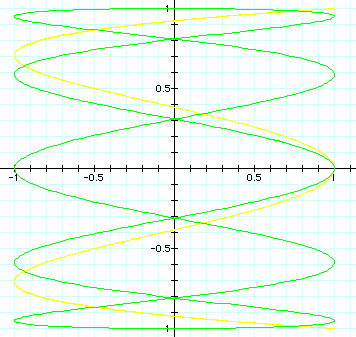
We can imagine the case when only cosine has the multiple. The following is the graph when it is multiples to cosine.
Return to my homepage