
Polar coordinates of a point P
In the plane we choose a fixed point O, and
we call it the pole.
Additionally we choose an axis x through the pole and call it
the polar axis.
On that x-axis, there is just 1 vector E such that abs(E)=1.
The pole and the polar axis constitute the basis of the polar
coordinate system.
Now, we take a point P.
On the line OP we choose an axis u.
The number t is a value of the angle from the x-axis to the u-axis.
The number r is such that P = r.U
The numbers r and t define unambiguous the point P.
We say that (r,t) is a pair of polar coordinates of P.
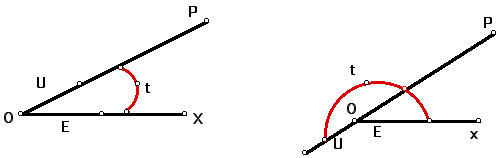
The polar coordinates of the pole O are by definition (0,t) with t perfectly arbitrary.
Polar
equation of a curve.
Consider a connection between the polar coordinates
of a point and suppose, that connection can be expressed in the
form
F(r,t)=0 or maybe in the explicit form r = f(t).
Such equation is a polar equation of a curve.
With each solution (ro,to) of the polar equation, corresponds
a point with polar coordinates (ro,to). Generally the equation
has
an infinity number of such solutions and so, we have an infinity
number of points. The set of all these points is the curve of
the
equation.
Each point P of that curve has at least one
pair of polar coordinates who satisfy the equation. Note that,
in general, not all pairs
of polar coordinates of P are solutions of the equation.
Note that one curve can have different polar equations.
Click here for the examples
Let's investigate  .
.
How about when a=b? The following graph shows the equations when k varies from 1 to 3.
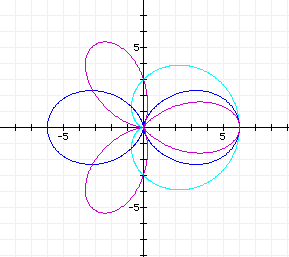
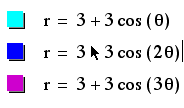
How about the graph of various a, b(a=b)? The following graph shows the equations when k=1.
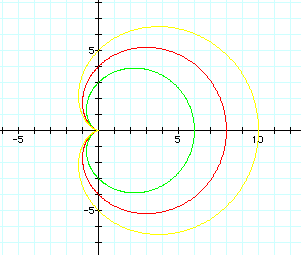
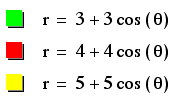
We can see that the bigger a and b are, the
wider the width. If so how about if a and b are 10, 50 or 100.
You can click here to match your thought of
the graph.
Let's think about the curve which has the shape
of a petalled flower. Compare the following two equation .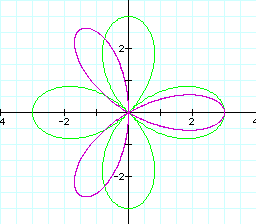
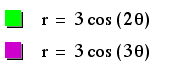
If k is odd, the rose is k-petalled. If k is even, the rose is 2k-petalled. If k is irrational, then there are an infinite number of petals.
Now investigate the orginal starting equation
.
When a and b are equal, and k is an integer,
this becomes the "n-petalled rose." Click here
to check the graph of the variou k.
Return
to my homepage