
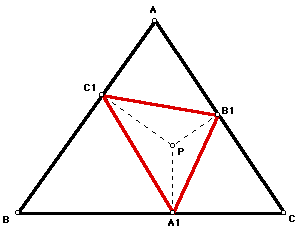
The orthic triangle and the medial trianglee are two instances of a more general type of associated triangle. Let P be any point inside a given triangle ABC, and let perpendiculars PA1,PB2.PC3 be dropped to the three sides BC, CA, AB, as below figure. The feet of these perpendiculars are the vertices of a triangle A1B1C1 which is called the pedal triangle of triangle ABC for the pedal point P. The restrction of P to interior positions can be relaxed if we agree to insist that P shall not lie on the circumcircle of triangle ABC. Clearly, the orthic triangle or the medial triangle arises when P is the orthocenter or the circumcenter, respectively.
Click here for the
GSP file
Let us examine the above figure more closely.
the right angles at B1 and C1 indicate that these points lie on
the circle with diameter AP; in other words, P lies on the circumcircle
of triangle AB1C1. Applying the law of sines to this triangle
and also to triangle ABC itself, we obtain
whence
Similary,
We proved thus proved;
Theorem:
If the pedal point is distant x,y,z from the vertices of triangle
ABC, the pedal triangle has sides
The case when x=y=z=R is of course, familiar.
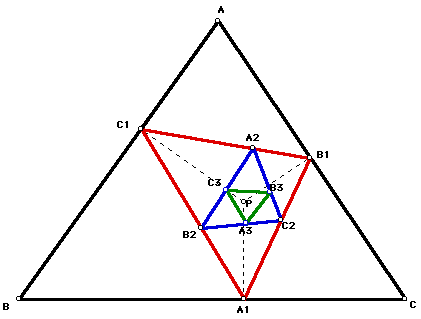
An interesting exercise involving pedal triangles is at the same time a delightful example of imagination in geometry. In the following figure, an interior point P has been used to determine triangle A1B1C1, the (first) pedal triangle of triangle ABC. The same pedal point P has been used again to determine triangle A2B2C2, the pedal triangle of triangle A1B1C1,which we naturally call the "second pedal triangle" of triangle ABC. A third operation yields triangle A3B3C3, the pedal triangle of triangle A2B2C2. The understanding is that, for this " third pedal triangle" also, we use the same pedal point P.
Click here fo rthe GSP file
In this terminology, Neuberg's discovery can be expressed thus:
Theorem: The third triangle is similar to the
original triangle.
Return
to homepage

