
Stephanie K. Lewis
Final Assignment
Fall, 1998
Part 1
A. Consider any triangle ABC. Select a point P inside the triangle and draw lines AP, BP and CP extended to their intersections with the opposite sides in points D, E, and F respectively.
Explore (AF) (BD) (EC) and (FB) (DC) (EA) for various triangles and various locations of P.
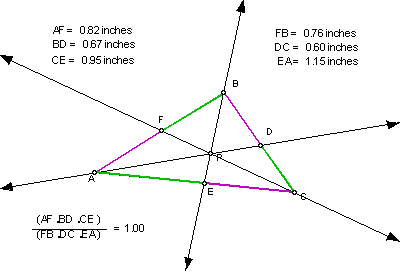
After exploring several different locations of P and various triangles for (AF) (BD) (EC) and (FB) (DC) (EA), I found that the ratio of (AF
· BD· EC) and (FB · DC · EA) is 1.00. This held true for all positions of P in the interior of triangle ABC.
B. Conjecture?
If (AF
· BD· EC) and (FB · DC · EA) have a 1:1 ratio, then it stands to reason that the segments that comprise this ratio are in proportion to one another. To prove this conjecture, I utilized a similar triangle corollary that states "if a second triangle is formed by a line that is parallel to a side of the first triangle", then similar triangles can be established. Similar triangles, yield proportional sides!!!!To that end, I drew a line parallel to side AC which intersected vertex B. Where the parallel line intersects with the extension of ray BE, triangle BND was formed. Please refer to the diagram below.

Line BN is parallel to line AC. Segment BC is the transversal. When lines are parallel, alternate interior angles exist. Therefore <BND
ª <DAC, and < NBD ª <DCA. Since vertical angles are congruent, <BDN ª <ADC. Triangle BDN is similar to triangle CDA since all three angles in one are congruent to all three angles in the other. Thus segment BD is similar to segment CD.Upon further investigation, we see that BD:BN as DC:AC. Triangle BDN is indeed similar to triangle CDA since their sides are proportional.
If parallel lines are drawn through the other two vertices of triangle ABC such that the lines are parallel to the to the opposite side of the triangle, similar triangles are formed, and AE is similar to EC, and AF is similar to BF. And , (AF
· BD· EC) to (FB · DC · EA) is indeed 1:1.I could not make the above generalization when point P was on the outside of triangle ABC.
Consider triangles FBD, DCE, EAF and EFD. Each triangle is proportional to one another since their sides are proportional. Note, that each make up the interior of the larger triangle ABC as can be seen from the diagram below.
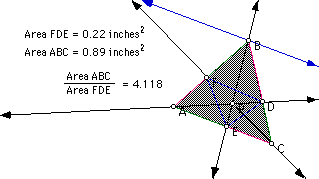
Since the sum of the areas of triangles FBD, DCE, EAF and EFD make up the larger triangle ABC, then the area of one triangle would be representative of only 1/4 of the total area, while the other three triangles represent 3/4 of the total area. The total area is 4/4. So, the ratio of the total area to one triangle would be 4/4 to 1/4, which equals 4:1.
The ratio of the area of ABD and DEF is exactly 4 when point P is the centroid of triangle ABC.
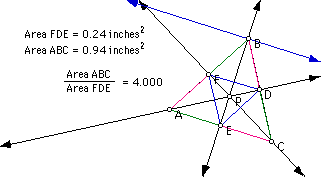
As point P moves closer to the vertices of the triangle, then the ratio of triangle ABD to FDE is greater than four.
Part 2: Course Evaluation
Dr. Wilson,
Even though the Geometric Sketchpad gave me nightmares, I really enjoyed the class. Perhaps, I would have felt better if I had a hard copy how-to for the geometric sketchpad. Learning as you go was very time consuming , and sometimes, frustrating.
I certainly know more about the basic operation of computers than I knew prior to entering this class. And, next semester, I hope to learn more.
Have a wonderful holiday season.