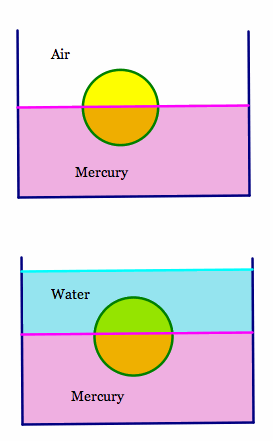
Iron Ball Floating in Mercury
In Mathematical Discovery, George Polya presents the following problem:
An iron sphere is floating in mercury. Water is poured over the mercury and covers the sphere. Will the sphere sink, rise, or remain at the same depth?
What is the argument for your conclusion?
Hint: Suppose the fluid we poured into the upper part of the vat was more mercury. What would happen to the ball?
Compute fhe fraction of the volume the iron ball that is above the top level of the mercury in each situation. Answering this quantitative question will help answer and justify the answer to the original question.
Hint: Review the Law of Archimedes
The Law of Archimedes states that a floating body is buoyed up by a vertical force equal in magnitude to the weight of the displaced fluid.
Here are two web pages that present discussion of buoyancy -- why things float. They are nice explorations to complement our problem:
http://www.science-niblets.org/physics/why-can-heavy-steel-ships-float.html
http://www.bolsovercruiseclub.com/cruise-infographics/why-do-ships-float/#.VZqXzEUXrmv
Thanks to Georgia Crawford for calling our attention to these investigations.
Setting up
If we take the specific gravity of a substance and multiply by the volume, we will get the weight. Set
a = specific gravity in the upper "fluid" (air in the first stage and water in the second stage)
b = specific gravity in the lower "fluid" (mercury in both stages)
c = specific gravity of the floating solid (iron in both stages)
v = total volume of the floating solid
x = volume of the floating solid that is in the upper fluid
y = volume of the floading solid that is in the lower fluid
We can write two equations in terms of x and y:
x + y = v (The total volume of the floating body is the sum of the two parts.)
ax + by = cv (The weight of sphere -- cv -- is balance by the combined weights of the two displaced fluids
Solve for x and y in terms of a, b, c, and v
Completion and interpretation to answer our question
Note:
The handling of mercury is too dangerous to try to implement this as a physical experiment. Design a parallel investigation using a weighted cork floating in water for the first stage and then adding cooking oil over the water and cork for the second stage. The visual separation of the water and oil can be enhanced by adding a few drops of food coloring to the water.
There are many sites on Google for science experiments with multiple fluids and investigations of objects that float or sink in the different fluids.