
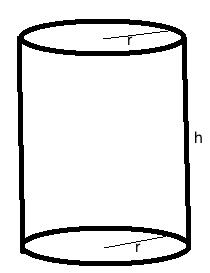
In packaging a product in a can the shape of right circular cylinder, various factors such as tradition and supposed customer preferences may enter into decisions about what shape (e.g. short and fat vs. tall and skinny) can might be used for a fixed volume. Note, for example, all 12 oz. soda cans have the same shape -- a height of about 5 inches and a radius of about 1.25 inches. Why?
What if the decison was based on minimizing the material used to make the can? This would mean that for a fixed volume V the shape of the can (e.g. the radius and the height) would be determined by the minimum surface area for the can. What is the relationship between the radius and the height in order to minimize the surface area for a fixed volume?
What would be the shape of a 12 ounce soda can that minimizes the amount of aluminum in the can?
Note: You undoubtedly have seen this problem before in calculus. Do it WITHOUT calculus.
Try using a spreadsheet. Fix V at some constant. Make a column for r and compute a column for h. Make a graph of S as a function of r or h.
Want to see a Graph of 12 oz can surface area as a function of the radius?
Try using the arithmetic mean-- geometric mean inequality.
Want to see a solution via the Arithmetic Mean -- Geometric Mean Inequality?
Give up? Here's the
Bottom Line