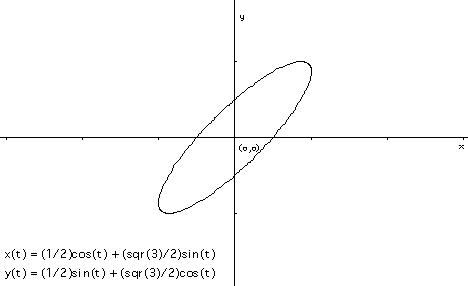
We begin with the following problem:
- Find the locus of the third vertex of an equilateral triangle when two of its vertices are moved along the x-axis and y-axis respectively.
Let us explore this problems and some of its extensions.
INVESTIGATION:
- Try this first by cutting out a triangle and physically rotating it along the axes, marking the locus of the third vertex. Can this physical movement be animated on the computer?
- Repeat with other triangles -- scalene, isosceles, obtuse, acute, right . . .
- Note that a scalene triangle could generate 6 different loci, depending on which vertices are along the axes and the orientation of the triangle. How are the six related?
- Special case: The locus of the 90 degree angle in a right triangle when the vertices of the acute angles are on the axes.
- Can you prove the locus is an ellipse (or a degenerate ellipse)?
- Consider the "special case" of a triangle with zero height. In other words, what is the locus of a point on a fixed line segment as the segment is rotated with its ends on the x and y axes? (Simplest cases: the loci of the end points. Next simplest case: the midpoint.)
OBSERVATION: The Vacuum Grinder
A mechanical device that physically rotates in this way is a cutter for oval openings in picture matting. There is also an adult toy, sometimes called "the vacuum grinder," that uses the same principle. I have one on my desk.
The vacuum grinder is a toy for keeping executives busy and therefore not interfere with the work of those they supervise. Moving the handle, the attached points slide along the two slots at right angles. Most of the time if you ask someone operating the vacuum grinder "What path is traced out by the handle?" they will say "It moves in a circle."
Being more aware, as mathematics teachers, we know the path is an ellipse. Further, fixed points on the handle other than the pivot points (these move along the axes) and the midpoint between the axes (it moves in a circle) will have an ellipse for its locus.The matting cutter for cutting ovals at a frame shop works on the same principle.
ANALYSIS:
Let the base of the triangle be positioned with vertices at (0,0) and (1,0) for the initial position of the triangle. Let the third vertex be at (a,h). Therefore, the altitude of the triangle is h and the projection of the vertex onto the x-axis is a.
As the triangle rotates, let t be the angle the base makes with the x-axis. Then parametric equations for x(t) and y(t) are: (proof left as an exercise for the reader)
x(t) = a cos(t) + h sin(t)
y(t) = (1-a) sin(t) + h cos(t)
Note: The above graph was generated using Mathematics Teacher Workstation from Sterling Swift Software, Austin, Texas. The author is Ray Carry.
Please continue the INVESTIGATION using a function grapher.
- What if
a = 3/4, h = 2?
a = 5/4, h = 1?
a = -1/4, h = 1?
a = 1/2, h = 1/2?- What if the vertices for the base of the triangle rotated along two lines intersecting at a 60° angle? (That is, the x and y coordinates are at 60 degrees rather than 90 degrees.)
- Create GSP sketches to show the locus of the third vertex of a triangle when two of its vertices are moved along the x and y axes.
- Write the equation for the locus in Cartesian form rather than parametric.