
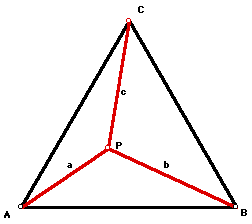
Given an equilateral triangle ABC with sides of length 1. Let P be a point in the plane of ABC and let a, b, and c be the respective distances PA, PB, and PC. What is the locus of P for a+b+c = K, where K is a constant greater than
?
Observations
For any triangle, the minimum sum of the distances from an interior point to the three vertices is when the interior point is the Fermat point -- the point where each of the sides of the triangle is under an angle of 120 degrees. Therefore, when K is
When K = 2, each of the vertices is part of the locus, and further, no point on the interior of the triangle is part of the locus.
An attempt that did not go anywhere -- yet.
A Geometrer's SketchPad drawing produced the following estimates of points on the locus when the length of a+b+c was about 1.9. This was done by dividing a fixed line segment into three parts and then constructing circles from each of the three vertices. The parts of the fixed segment could be varied to find common intersection points. Not satisfactory, but convinicing that the locus is not a circle.
Is this locus constructable with elementary geometry tools?
A Different Approach.
Using the Coordinate System Approach for other values of K.
First, choose a position in the coordinate system and locate the three vertices A, B, and C
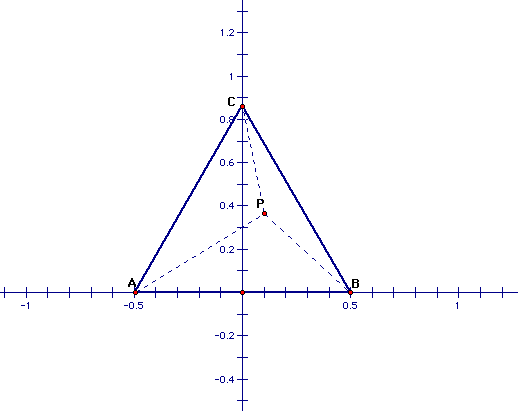
Using the distance function, write a formula for the distances PA, PB, and PC where (x,y) is the variable point P.
Here are the graphs for K = 1.8, 2, and 2.2. Click here for a Graphing Calculator file. Vary K.
The picture shows the graphs of the locus, from inside to outside, for various values of K.
K = 2.3, 2.1,2.2, 2.0 1.9, 1.8, 1.75 and 1.733
And, in living color, without the superimposed drawing of the triangle:
An extension to Non-Equilateral Triangles
Consider the acute scalene triangle with vertices at A = (-1, 0), B = (3, 0), and C = (0,2). The loci for values of K from about 5.5 to 7.7 are shown below. The triangle ABC has not been superimposed on this picture.
Extension -- Four Points
