
The Census Taker
During the recent census, a man told the census-maker that he had three children. When asked their ages, he replied, "The product of their ages is 72. The sum of their ages is the same as my house number."
Here are the facts of the problem:
There are three children. Let's label them a, b, and c.
The product of their ages is 72. Therefore, a x b x c = 72.
The sum of their ages is the same as the house number. Therefore, a + b + c = x.
First, let's list the possibilities of a x b x c = 72.
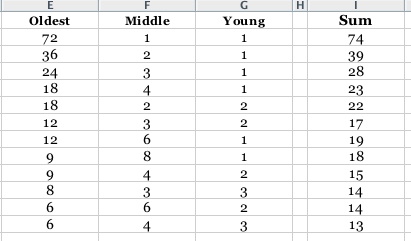
The most strange part of this problem for me was the statement from the man informing the census taker that his oldest child likes chocolate pudding. My initial thought was, "What in the world does that have to do with anything???"
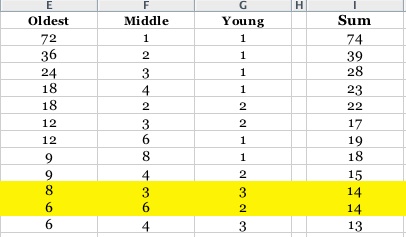
Clearly, the census taker knows the man's house number. The information that he/she is looking for are the ages of the man's children. We can see in the chart that the only sum that has more than one combination of mutipliers is 14.
Reference: Dr.
Jim Wilson's EMAT 6600 Page