
1. When will the cost of a first class postage stamp reach $1.00?
2. When will the cost be 74 cents?
3. How soon should we expect the next increase?
4. In 1996, the analysis of stamp data historically seemed to show that the postage doubled every 10 years approximately. The cost in 2006 would seem to argue that pattern is no longer valid. Is there evidence to show a change in the growth pattern? Or, was the 'doubles every ten years' just a bad model?
Let's examine the spreadsheet created in Assignment 12 to observe the possibilities of the rate of increase for first class postage stamps in the United States.
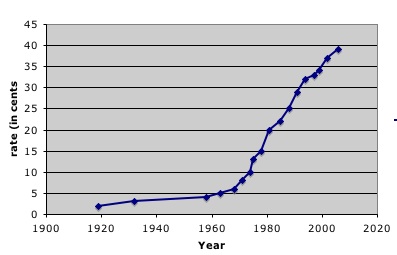
Recall: We used the power function 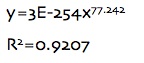 to yield the following data:
 |
 |
In order to predict when the cost of a first class postage stamp reach $1.00, we can input 100 as the Actual rate to yield the predicted year.
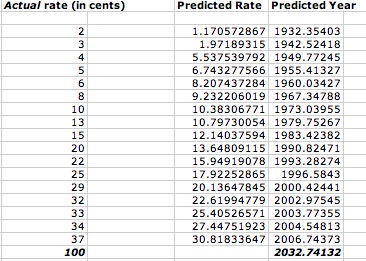
Now, predict when the postage stamp will cost 74 cents.
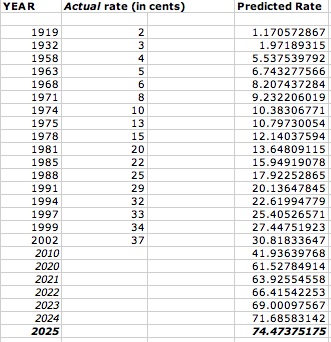
The evidence shows that the 'doubles every ten years' model for the growth pattern in postage stamp price is not accurate. If we look at the past trends, we will see that his model does not hold.
From 1971 to 1981, the price increased from 8 cents to 20 cents. From 1981 to 1991, the price increased from 20 cents to 29 cents. Also, if we use our predicted rates, the predicted rate in the year 2010 is approximately 42 cents. In the year 2020, the predicted price is approximately 61 cents. Neither one of these relationships support the 'doubles every ten years' model. Therefore, it can be concluded that this model is a bad model.